Economics past questions: WAEC SSCE 2023
49 objective questions, with answers. Free to read and practise.
Sit this paper
49 questions, one at a time, marked as you go or at the end. No account needed.
- 1.A country is described as developing if
- A.the income per head is low
- B.the contribution of tertiary sector to national income is high
- C.the population is decreasing
- D.there is low labour supply
Show answerHide answer
Answer: A the income per head is low
- 2.A fall in the price of a normal commodity which has elastic demand will result in
- A.a fall in demand
- B.a fall in quantity demanded
- C.an increase in revenue
- D.a decrease in revenue
Show answerHide answer
Answer: C an increase in revenue
- 3.A government may cause a favourable change in her invisible trade account by
- A.developing tourism and other services
- B.imposing high tariff on exports
- C.encouraging people to go for medical treatment abroad
- D.increasing the export of her primary products
Show answerHide answer
Answer: A developing tourism and other services
- 4.A joint stock company enjoys perpetual existence because
- A.there is a higher degree of specialization
- B.it is a corporate entity
- C.it is formed by a minimum of seven members
- D.its shares are easily
Show answerHide answer
Answer: B it is a corporate entity
- 5.A monopolist may enjoy abnormal profit only if its
- A.marginal cost exceeds marginal revenue
- B.demand curve is perfectly elastic
- C.expenditure on advertisement increases
- D.price exceeds average total cost
Show answerHide answer
Answer: D price exceeds average total cost
- 6.A small scale firm located within an industrial estate will enjoy
- A.government protection and funding
- B.technological economies of scale
- C.financial economies of scale
- D.external economies of scale
Show answerHide answer
Answer: D external economies of scale
- 7.An economy system is mainly concerned with
- A.studying the relationship between ends and means
- B.the allocation of scarce resources between alternative ends
- C.handling situations of abudant resources
- D.the establishment of economic laws
Show answerHide answer
Answer: B the allocation of scarce resources between alternative ends
- 8.An example of government's recurrent expenditure is
- A.electrification projects in rural areas
- B.the cost of building a school
- C.purchase of new vehicles
- D.paying salaries of workers
Show answerHide answer
Answer: D paying salaries of workers
- 9.An indication that there is inflation in a country is that
- A.there is a decrease in the demand for goods and services
- B.there are too many goods in circulation
- C.the same amount of money buys lower quantity of goods
- D.people prefer to lend than to borrow
Show answerHide answer
Answer: C the same amount of money buys lower quantity of goods
- 10.Assisting members to solve temporary balance of payments problems is the reasons for the establishment of the
- A.International Monetary Fund
- B.Economic Commission for Africa
- C.World Bank
- D.African Development Bank
Show answerHide answer
Answer: A International Monetary Fund
- 11.At what point on the total product curve shown above will marginal product be negative?
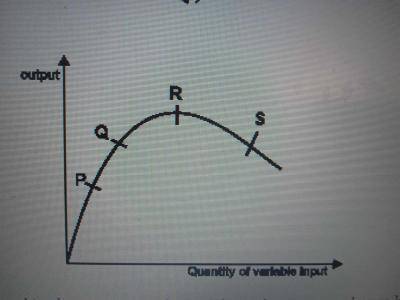
- A.Q
- B.S
- C.R
- D.P
Show answerHide answer
Answer: B S
- 12.Commericial banks help in economic development mainly by
- A.acting as trustees and executors of wills
- B.acting as intermediaries between government and borowers
- C.serving as custodians of valuables
- D.giving financial advice to the government
Show answerHide answer
Answer: B acting as intermediaries between government and borowers
- 13.Consumers have access to a variety of goods through the activities of the
- A.retailers
- B.advertising agencies
- C.mass media
- D.wholesalers
Show answerHide answer
Answer: A retailers
- 14.Country M enjoys absolute advantage over country N in the production of commodities X and Y, if country M
- A.is inefficient in the production of both commodities X and Y
- B.is more efficient than country N in producing both commodities X and Y
- C.can produce only commodity Y cheaper than country N
- D.and country N are efficient in the production of both goods
Show answerHide answer
Answer: B is more efficient than country N in producing both commodities X and Y
- 15.If a firm retrenches some of its factory workers its
- A.average fixed cost may increase
- B.variable cost will decline
- C.marginal cost may increase
- D.fixed cost is likely to increase
Show answerHide answer
Answer: B variable cost will decline
- 16.If the demand for a commodity remains constant as price increases, the commodity is said to be
- A.perfectly price inelastic
- B.unit price elastic
- C.price elastic
- D.price inelastic
Show answerHide answer
Answer: D price inelastic
- 17.If the government stops subsidy on cocoa production, the supply curve of cocoa will
- A.become vertical
- B.remain unchanged
- C.shift to the left
- D.shift to the right
Show answerHide answer
Answer: B remain unchanged
- 18.Industries are sometimes located in areas which are not profitable so as to
- A.encourage rural-urban migration
- B.be able to even-out development
- C.bring about external economies of scale
- D.be able to reap internal economies of scale
Show answerHide answer
Answer: B be able to even-out development
- 19.Many workers are employed in the agricultural sector of developing countries because
- A.labour intensive method is mostly adopted
- B.abnormal profits are made
- C.wages in the sector is high
- D.they practice mechanized system of farming
Show answerHide answer
Answer: A labour intensive method is mostly adopted
- 20.Money is able to function more as a medium of exchange when
- A.there is a fall in production
- B.more prople engage in subsistence production
- C.individuals and nations are self-sufficient
- D.there is specialization of labour
Show answerHide answer
Answer: D there is specialization of labour
- 21.National income is calculated mainly to
- A.determine how income is to shared
- B.help firms generate more funds
- C.determine aid to to be received from other nations
- D.determine the level of sectoral performance
Show answerHide answer
Answer: D determine the level of sectoral performance
- 22.One of the factor that may not promote industrial development is
- A.local firms entering into partnerships with foreign firms
- B.granting capital to firms at reasonable interest rates
- C.setting up industrial estates with modern amenities
- D.granting old firms tax exemptions
Show answerHide answer
Answer: D granting old firms tax exemptions
- 23.Petrol and Kerosene are jointly obtained from crude oil. If the supply of petrol increases, the
- A.cost of crude oil production has increased
- B.supply of kerosene will rise
- C.supply of kerosene will remain unchanged
- D.supply of kerosene will fall
Show answerHide answer
Answer: B supply of kerosene will rise
- 24.Resources are pooled for the mutual benefit of its members mainly in a
- A.cooperative society
- B.joint stock company
- C.private company
- D.partnership
Show answerHide answer
Answer: A cooperative society
- 25.Tariffs, quotas and embargoes are examples of
- A.trade restriction policies
- B.monetary policies
- C.fiscal policies
- D.foreign exchange policies
Show answerHide answer
Answer: A trade restriction policies
- 26.Taxes levied on goods and services by government are called
- A.indirect taxes
- B.direct taxes
- C.coporate taxes
- D.poll taxes
Show answerHide answer
Answer: A indirect taxes
- 27.The average revenue curve of a firm in a perfect market is the same as the
- A.supply curve of the firm
- B.average cost curve of the firm
- C.demand curve of the firm
- D.total revenue curve of the firm
Show answerHide answer
Answer: C demand curve of the firm
- 28.The demand for a factor input as a result of the demand for its output is known as
- A.market demand
- B.complementary demand
- C.competitive demand
- D.derived demand
Show answerHide answer
Answer: D derived demand
- 29.The dependency ratio of a country is the
- A.the children and aged who rely on the active population for support
- B.people who are cared for by their extended families
- C.total active population who depend on government for survival
- D.number of children who depend on their parents for survival
Show answerHide answer
Answer: A the children and aged who rely on the active population for support
- 30.The fixing of maximum prices by government is mainly on
- A.imported capital goods
- B.inferior goods
- C.selected essential goods
- D.luxury goods
Show answerHide answer
Answer: C selected essential goods
- 31.The malthusian theory of population is best illustrated when
- A.the size of the population and available resources are equal
- B.both population and food supply increase at the same rate
- C.food supply increases much faster than population growth
- D.population increases much faster than food supply
Show answerHide answer
Answer: D population increases much faster than food supply
- 32.The marks obtained by 9 students in a class test are recorded below: 9, 8, 7, 5,7, 6, 8, 9 and 7. What is the median mark?
- A.7
- B.8.5
- C.8
- D.7.5
Show answerHide answer
Answer: A 7
- 33.The Net National Product (NNP) of a country is $50m while the depreciation allowance is $10m. The Gross National Product (GNP) is
- A.$40m
- B.$60m
- C.$30m
- D.$500m
Show answerHide answer
Answer: B $60m
- 34.The price level and the value of money are
- A.positively related
- B.directly related
- C.not related
- D.inversely related
Show answerHide answer
Answer: D inversely related
- 35.The rate of growth of population is
- A.initial population plus number of births and net migration
- B.the difference between birth rate and death rate
- C.birth rate less death rate plus net migration
- D.the number of immigrants plus number of births
Show answerHide answer
Answer: C birth rate less death rate plus net migration
- 36.The study of economics is mainly concerned with how to
- A.rank individuals' wants given the abundant resources
- B.make choice when resources are inadequate
- C.satisfy every member of all societies
- D.produce all the goods needed by everyone
Show answerHide answer
Answer: B make choice when resources are inadequate
- 37.The supply of light could be met using a candle, lantern and gas lamp. This is an example of a
- A.complementary supply
- B.abnormal supply
- C.joint supply
- D.composite supply
Show answerHide answer
Answer: A complementary supply
- 38.The total fixed cost curve is
- A.horizontal
- B.upward sloping
- C.vertical
- D.downward sloping
Show answerHide answer
Answer: C vertical
- 39.To overcome the problem of double counting under the expenditure approach,
- A.spending on intermediate goods and inputs are considered
- B.valued added method is used
- C.proper accounting standards must be used
- D.only spending on final goods are considered
Show answerHide answer
Answer: D only spending on final goods are considered
- 40.Trade protection will assit economic growth in developing countries if it can
- A.allow the importation of cheaper goods people want
- B.effectively safeguard newly established firms
- C.eliminate importation of all commodities
- D.generate enough revenue through export duties
Show answerHide answer
Answer: B effectively safeguard newly established firms
- 41.Use the graph above to answer the question The curve labelled W shows the
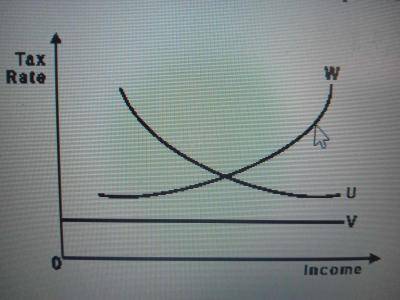
- A.regressive tax
- B.proportional tax
- C.specific tax
- D.progressive tax
Show answerHide answer
Answer: D progressive tax
- 42.Warehousing is an economic activity that falls under
- A.secondary production
- B.primary production
- C.tertiary production
- D.intermediate production
Show answerHide answer
Answer: D intermediate production
- 43.When job vacancies are publicized, the government is mainly trying to solve the problem of
- A.residual unemployment
- B.cyclical unemployment
- C.technological unemployment
- D.frictional unemployment
Show answerHide answer
Answer: D frictional unemployment
- 44.When more of tax on a product is borne by the buyer than the seller, the commodity involved has
- A.perfectly elastic demand
- B.perfectly inelastic demand
- C.fairly inelastic demand
- D.elastic demand
Show answerHide answer
Answer: C fairly inelastic demand
- 45.When the demand for a commodity increases while supply remains unchanged, the equilibrium price and quantity will
- A.increase
- B.remain constant
- C.decrease
- D.turn negative
Show answerHide answer
Answer: A increase
- 46.When the marginal utility from the consumption of commodity X (Mux) is greater than the price commodity X (Px), a rational consumer should
- A.strive to remain in disequilibrium
- B.consume the same quantity of commodity X
- C.consume more of commodity X
- D.reduce consumption of commodity X
Show answerHide answer
Answer: C consume more of commodity X
- 47.Which of the following is a non-renewable natural resources?
- A.Rubber
- B.Oil palm
- C.Coal
- D.Cocoa
Show answerHide answer
Answer: C Coal
- 48.Which of the following is not a problem facing Economic Community of West African States (ECOWAS)?
- A.Language barriers
- B.Inadequate supply of labour
- C.Production of the same commodities
- D.Poor transportation and communication
Show answerHide answer
Answer: B Inadequate supply of labour
- 49.Which of the following items is not classified as working capital?
- A.Fuel
- B.Money to pay wages
- C.Semi-finished goods
- D.Equipment
Show answerHide answer
Answer: D Equipment
Printing is turned off here to protect the question bank. Get the SmarTest app to study offline.
More free Economics papers
WAEC Economics 1988–2020 is in the app
The latest five years of each paper are free here. The SmarTest app has every year we hold, a worked explanation for each answer, and timed mock exams. It works offline.
Android, Windows, Mac and Linux