Physics past questions: JAMB UTME 2023
64 objective questions, with answers. Free to read and practise.
Sit this paper
64 questions, one at a time, marked as you go or at the end. No account needed.
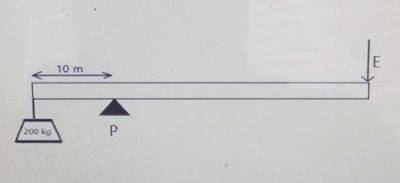
- 1.A 200 kg load is raised using a 110 m long lever as shown in the diagram above. The load is 10m from the pivot P. If the efficiency of the the lever is 80%, find the effort E required to lift the load. [Take g = 10ms-2]
- A.250
- B.300
- C.450
- D.200
Show answerHide answer
Answer: A 250
- 2.A 35 kΩ is connected in series with a resistance of 40 kΩ. What resistance R must be connected in parallel with the combination so that the equivalent resistance is equal to 25 kΩ?
- A.40 kΩ
- B.37.5 kΩ
- C.45.5 kΩ
- D.30 kΩ
Show answerHide answer
Answer: D 30 kΩ
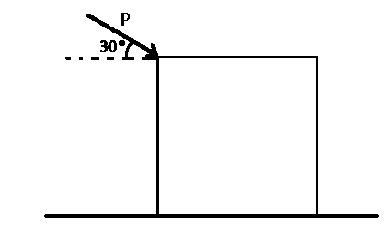
- 3.A 400 N box is being pushed across a level floor at a constant speed by a force P of 100 N at an angle of 30.0° to the horizontal, as shown in the the diagram below. What is the coefficient of kinetic friction between the box and the floor?
- A.0.19
- B.0.24
- C.0.40
- D.0.22
Show answerHide answer
Answer: B 0.24
- 4.A beam of light travelling in water is incident on a glass which is immersed in the water. The incident beam makes an angle of \(40^o\) with the normal. Calculate the angle of refraction in the glass. [Refractive index of water = 1.33, Refractive index of glass = 1.5]
- A.\(29.36^o\)
- B.\(25.37^o\)
- C.\(37.21^o\)
- D.\(34.75^o\)
Show answerHide answer
Answer: D \(34.75^o\)
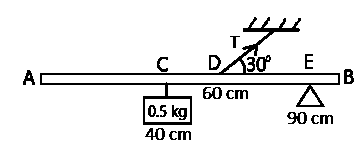
- 5.A block of mass 0.5 kg is suspended at the 40 cm mark of a light metre rule AB that is pivoted at point E, the 90 cm mark, and is kept at equilibrium by a string attached at point D, the 60 cm mark, as shown in the figure above. Find the tension T in the string. [Take g = \(10 ms-2\) ]
- A.16.67N
- B.15.67N
- C.14.67N
- D.18.67N
Show answerHide answer
Answer: A 16.67N
- 6.A charge of \(4.6 × 10^{-5}\) C is placed in an electric field of intensity \(3.2 × 10^4\) \(Vm^{-1}\) . What is the force acting on the electron?
- A.1.5 N
- B.3.7 N
- C.4.2 N
- D.2.5 N
Show answerHide answer
Answer: A 1.5 N
- 7.A generator manufacturing company accidentally made an AC generator instead of a DC generator. To fix this error,
- A.the magnetic field needs to be made stronger
- B.the split rings should be replaced with slip rings
- C.the number of turns of the armature coil needs to be decreased
- D.the slip rings should be replaced with split rings
Show answerHide answer
Answer: D the slip rings should be replaced with split rings
- 8.A lorry accelerates uniformly in a straight line with acceleration of \(4ms^-2\) and covers a distance of 250 m in a time interval of 10 s. How far will it travel in the next 10 s?
- A.650
- B.900
- C.800
- D.250
Show answerHide answer
Answer: A 650
- 9.A metal sphere is placed on an insulating stand. A negatively charged rod is brought close to it. If the sphere is earthed and the rod is taken away, what will be the charge on the sphere?
- A.The sphere will remain neutral
- B.The sphere will have a net negative charge
- C.The sphere will have a net positive charge
- D.The sphere will become polarized
Show answerHide answer
Answer: C The sphere will have a net positive charge
- 10.A missile is launched with a speed of 75 ms-1 at an angle of 22° above the surface of a warship. Find the horizontal range achieved by the missile. Ignore the effects of air resistance. [Take g = 10 ms-2]
- A.195
- B.271 m
- C.391 m
- D.136 m
Show answerHide answer
Answer: D 136 m
- 11.A parallel plate capacitor separated by an air gap is made of \(0.8m^2\) tin plates and 20 mm apart. It is connected to 120 V battery. What is the charge on each plate? Take \(ε_o\) = \(8.85×10^-12 Fm^-1\)
- A.3.54nC
- B.42.5nC
- C.35.4nC
- D.4.25nC
Show answerHide answer
Answer: B 42.5nC
- 12.A piano wire 50 cm long has a total mass of 10 g and its stretched with a tension of 800 N. Find the frequency of the wire when it sounds its third overtone note.
- A.800 Hz
- B.600 Hz
- C.400 Hz
- D.200 Hz
Show answerHide answer
Answer: A 800 Hz
- 13.A positively charged particle is placed near a negatively charged particle. What is the direction of the electric force between the two particles?
- A.The electric force is directed from the negative particle to the positive particle.
- B.The electric force is zero.
- C.The direction of the electric force cannot be determined.
- D.The electric force is directed from the positive particle to the negative particle.
Show answerHide answer
Answer: D The electric force is directed from the positive particle to the negative particle.
- 14.A relative density bottle has a mass of 19 g when empty. When it is completely filled with water, its mass is 66 g. What will be its mass if completely filled with alcohol of relative density 0.8?
- A.47 g
- B.52.8 g
- C.37.6 g
- D.56.6 g
Show answerHide answer
Answer: D 56.6 g
- 15.A simple pendulum, has a period of 5.77 seconds. When the pendulum is shortened by 3 m, the period is 4.60 seconds. Calculate the new length of the pendulum
- A.5.23 m
- B.6.42 m
- C.4.87 m
- D.7.26 m
Show answerHide answer
Answer: A 5.23 m
- 16.A step-down transformer is used on a 2.2 kV line to deliver 110 V. How many turns are on the primary windings if the secondary has 25 turns?
- A.20
- B.250
- C.200
- D.500
Show answerHide answer
Answer: D 500
- 17.A travelling wave of amplitude 0.80 m has a frequency of 16 Hz and a wave speed of 20 \(ms-1\) Calculate the wave number of the wave.
- A.3
- B.4
- C.5
- D.2
Show answerHide answer
Answer: C 5
- 18.A wire of radius 0.2 mm is extended by 0.5% of its length when supported by a load of 1.5 kg. Determine the Young's modulus for the material of the wire. [Take g = 10 ms \(^{-2}\) ]
- A.\(2.4×10^{10}(Nm^{-2})\)
- B.\(1.5×10^{10}(Nm^{-2})\)
- C.\(2.4×10^9(Nm^{-2})\)
- D.\(1.3×10^{10}(Nm^{-2})\)
Show answerHide answer
Answer: A \(2.4×10^{10}(Nm^{-2})\)
- 19.An air bubble of radius 4.5 cm initially at a depth of 12 m below the water surface rises to the surface. If the atmospheric pressure is equal to 10.34 m of water, the radius of the bubble just before it reaches the water surface is
- A.6.43 cm
- B.8.24 cm
- C.4.26 cm
- D.5.82 cm
Show answerHide answer
Answer: A 6.43 cm
- 20.An explosion occurs at an altitude of 312 m above the ground. If the air temperature is -10.00°C, how long does it take the sound to reach the ground? [velocity of sound at \(0^oC\) = 331 ms-1]
- A.0.94s
- B.0.96s
- C.0.93s
- D.0.95s
Show answerHide answer
Answer: B 0.96s
- 21.An object is placed 35 cm away from a convex mirror with a focal length of magnitude 15 cm. What is the location of the image?
- A.26.25 cm behind the mirror
- B.10.5 cm behind the mirror
- C.26.25 cm in front of the mirror
- D.10.5 cm in front of the mirror
Show answerHide answer
Answer: B 10.5 cm behind the mirror
- 22.An open-tube mercury manometer is used to measure the pressure in a gas tank. When the atmospheric pressure is 101,325 \(P_a\) , what is the absolute pressure in \(P_a\) in the tank if the height of the mercury in the open tube is 25 cm higher. density of mercury = \(13600kg/m^3, g = 9.8m/s^2\)
- A.108,986 Pa
- B.165,238 Pa
- C.122,364 Pa
- D.134,645 Pa
Show answerHide answer
Answer: D 134,645 Pa
- 23.Calculate the absolute pressure at the bottom of a lake at a depth of 32.8 m. Assume the density of the water is \(1 x 10^3\) kgm-3 and the air above is at a pressure of 101.3 kPa. [Take g = 9.8 ms-2]
- A.422.7
- B.220.14
- C.464.53
- D.321.74
Show answerHide answer
Answer: A 422.7
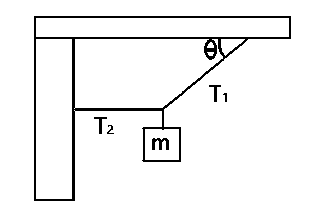
- 24.Find the tension in the two cords shown in the figure above. Neglect the mass of the cords, and assume that the angle is 38° and the mass m is 220 kg [Take g = 9.8 ms-2]
- A.\(T_1\) = 2864 N, \(T_2\) = 3612 N
- B.\(T_1\) = 3612 N, \(T_2\) = 2864 N
- C.\(T_1\) = 3502 N, \(T_2\) = 2760 N
- D.\(T_1\) = 2760 N, \(T_2\) = 3502 N
Show answerHide answer
Answer: C \(T_1\) = 3502 N, \(T_2\) = 2760 N
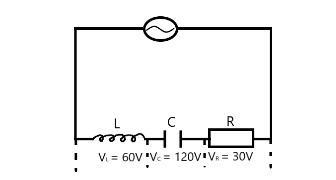
- 25.From the diagram above, if the potential differences across the resistor, capacitor, and inductor are 30V, 120V, and 60V, respectively, the effective potential difference is
- A.81
- B.67
- C.59
- D.73
Show answerHide answer
Answer: B 67
- 26.How much net work is required to accelerate a 1200 kg car from 10 \(ms^{-1}\) to 15 \(ms^{-1}\)
- A.1.95× \(10^5 j\)
- B.1.35× \(10^4 j\)
- C.7.5× \(10^4 j\)
- D.6.0× \(10^4 j\)
Show answerHide answer
Answer: A 1.95× \(10^5 j\)
- 27.How much work is done against the gravitational force on a 3.0 kg object when it is carried from the ground floor to the roof of a building, a vertical climb of 240 m?
- A.7.2 kJ
- B.4.6 kJ
- C.6.8 kJ
- D.8.4 kJ
Show answerHide answer
Answer: A 7.2 kJ
- 28.In an AC circuit, resonance occurs when the impedance of the circuit is:
- A.Zero
- B.Maximum
- C.Equal to the capacitive reactance of the circuit
- D.Minimum
Show answerHide answer
Answer: D Minimum
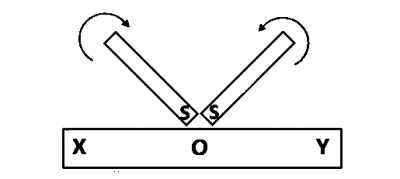
- 29.In the diagram above, if the south poles of two magnets stroke a steel bar, the polarities at X and Y will respectively be
- A.south and north
- B.north and south
- C.north and north
- D.south and south
Show answerHide answer
Answer: D south and south
- 30.Light of wavelength 589 nm in vacuum passes through a piece of fused quartz of index of refraction n = 1.458. What is the frequency of the light in fused quartz? [Speed of light c = \(3.00×10^8 ms^{-1}\) ]
- A.\(5.09×10^{15}\) Hz
- B.\(5.09×10^{14}\) Hz
- C.\(1.77×10^{15}\) Hz
- D.\(1.77×10^{14}\) Hz
Show answerHide answer
Answer: C \(1.77×10^{15}\) Hz
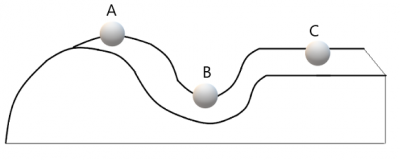
- 31.Name the type of equilibrium for each position of the ball
- A.A - unstable, B - neutral, C - stable
- B.A - stable, B - neutral, C - unstable
- C.A - stable, B - unstable, C - neutral
- D.A - unstable, B - stable, C - neutral
Show answerHide answer
Answer: D A - unstable, B - stable, C - neutral
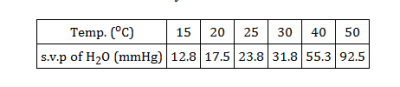
- 32.On a particular hot day, the temperature is 40°C and the partial pressure of water vapor in the air is 38.8 mmHg. What is the relative humidity?
- A.70
- B.62
- C.80
- D.42
Show answerHide answer
Answer: A 70
- 33.Rainbow formation is as a result of the combination of which of the following phenomena? (i) Reflection (ii) Dispersion (iii) Total internal reflection (iv) Refraction
- A.(ii) and (iv) only
- B.(i), (iii) and (iv) only
- C.(ii), (iii) and (iv) only
- D.(i), (ii) and (iv) only
Show answerHide answer
Answer: C (ii), (iii) and (iv) only
- 34.The branch of physics that deals with the motion of objects and the forces acting on them is called:
- A.Electromagnetism
- B.Thermodynamics
- C.Mechanics
- D.Quantum mechanics
Show answerHide answer
Answer: B Thermodynamics
- 35.The diagram above illustrates the penetrating power of some types of radiation. X, Y and Z are likely
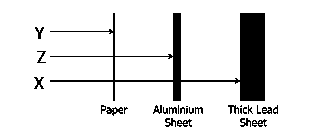
- A.X = α-particle; Y = γ-ray; Z = β-particle
- B.X = α-particle; Y = β-particle; Z = γ-ray
- C.X = γ-ray; Y = α-particle; Z = β-particle
- D.X = β-particle; Y = γ-ray; Z = α-particle
Show answerHide answer
Answer: C X = γ-ray; Y = α-particle; Z = β-particle
- 36.The electrolyte used in the Nickel-Iron (NiFe) accumulator is
- A.dilute tetraoxosulphate(VI) acid
- B.barium chloride solution
- C.potassium hydroxide solution
- D.sodium hydroxide solution
Show answerHide answer
Answer: A dilute tetraoxosulphate(VI) acid
- 37.The half life of a radioactive material is 12 days. Calculate the decay constant.
- A.0.8663 \(day^{-1}\)
- B.0.04331 \(day^{-1}\)
- C.0.17325 \(day^{-1}\)
- D.0.05775 \(day^{-1}\)
Show answerHide answer
Answer: C 0.17325 \(day^{-1}\)
- 38.The near point of a patient's eye is 50.0 cm. What power (in diopters) must a corrective lens have to enable the eye to see clearly an object 25.0 cm away?
- A.2 diopters
- B.2.5 diopters
- C.0.5 diopters
- D.3 diopters
Show answerHide answer
Answer: D 3 diopters
- 39.The number of holes in an intrinsic semiconductor
- A.is not equal to the number of free electrons
- B.is greater than the number of free electrons
- C.is equal to the number of free electrons
- D.is less than the number of free electrons
Show answerHide answer
Answer: C is equal to the number of free electrons
- 40.The pinhole camera works on
- A.the principle of the reversibility of light
- B.the principle of the rectilinear propagation of light
- C.Huygen's principle
- D.the principle of total internal reflection of light
Show answerHide answer
Answer: B the principle of the rectilinear propagation of light
- 41.The pitch of a musical note is determined by the frequency of the sound wave that it produces. If two instruments have the same frequency, which of the following factors will most affect the difference in their pitches?
- A.The shape of the instrument
- B.The tension of the string
- C.The size of the instrument
- D.The material of the instrument
Show answerHide answer
Answer: C The size of the instrument
- 42.The property of wave shown in the diagram above is?
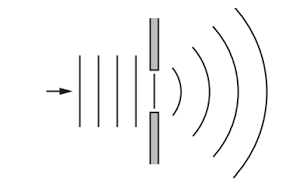
- A.Diffraction
- B.Refraction
- C.Polarisation
- D.Interference
Show answerHide answer
Answer: A Diffraction
- 43.The sensitivity of a thermometer is
- A.All of the above
- B.how quickly a temperature change can be detected
- C.the difference between the maximum and the minimum temperature
- D.the smallest temperature change that can be detected or measured
Show answerHide answer
Answer: D the smallest temperature change that can be detected or measured
- 44.The surface temperature of a swimming pool on a warm day is 25ºC and the temperature at the bottom is 15ºC. If the swimming pool has a surface area of 620 \(m^2\) and a depth of 1.5m. Find the rate at which energy is transferred by conduction from the surface to the bottom of the swimming pool. [Thermal conductivity of water (k) = 0.6071 Wm-1K-1]
- A.2.5kw
- B.250kw
- C.300kw
- D.3.0kw
Show answerHide answer
Answer: A 2.5kw
- 45.The terminals of a battery of emf 24.0 V and internal resistance of 1.0 Ω is connected to an external resistor 5.0 Ω. Find the terminal p.d.
- A.18.0V
- B.12.0V
- C.16.0V
- D.20.0V
Show answerHide answer
Answer: D 20.0V
- 46.The working of the beam balance is based on the principle of
- A.moments
- B.conservation of energy
- C.equivalence
- D.floatation
Show answerHide answer
Answer: D floatation
- 47.Three forces with magnitudes 16 N, 12 N and 21 N are shown in the diagram below. Determine the magnitude of their resultant force and angle with the x-axis
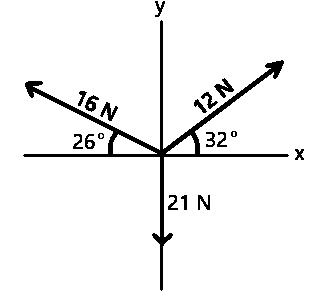
- A.7.63N,61°
- B.8.71N,61°
- C.7.63N,29°
- D.8.71N,29°
Show answerHide answer
Answer: B 8.71N,61°
- 48.What is the amount of heat required to raise the temperature of a 0.02 kg of ice cube from \(-10^oC\) to \(10^oC\) ? [specific latent heat of fusion of ice = 3.34 x \(10^5\) \(Jkg^-1\) , Specific heat capacity of water = 4200 \(Jkg^-1\) \(k^-1\) Specific heat capacity of ice = 2100 \(Jkg^-1\) \(k^-1\)
- A.6680 J
- B.1680 J
- C.7520 J
- D.7940 J
Show answerHide answer
Answer: D 7940 J
- 49.What is the name of the model of the atom that describes electrons as orbiting the nucleus in specific energy levels?
- A.Bohr model
- B.Dalton model
- C.Rutherford model
- D.Thomson model
Show answerHide answer
Answer: A Bohr model
- 50.When a water droplet is placed on a freshly cut piece of wood, it spreads out to form a thin layer because the wood is
- A.not at equilibrium with the water
- B.cohesive to water
- C.at equilibrium with the water
- D.adhesive to water
Show answerHide answer
Answer: D adhesive to water
- 51.When light of a certain frequency is incident on a metal surface, no photoelectrons are emitted. If the frequency of the light is increased, what happens to the stopping potential?
- A.The stopping potential does not change.
- B.The stopping potential decreases.
- C.The stopping potential can either increase or decrease, depending on the intensity of the light.
- D.The stopping potential increases.
Show answerHide answer
Answer: D The stopping potential increases.
- 52.Which of the following is a type of incandescent light source?
- A.Fluorescent lamp
- B.LED lamp
- C.Tungsten filament lamp
- D.Neon lamp
Show answerHide answer
Answer: C Tungsten filament lamp
- 53.Which of the following is a type of wave that is both mechanical and longitudinal?
- A.Water waves
- B.Seismic waves
- C.Sound waves
- D.Light waves
Show answerHide answer
Answer: C Sound waves
- 54.Which of the following is an example of a couple?
- A.All of the above.
- B.The forces that are applied to the handle of a screwdriver when you twist it.
- C.The forces that are applied to a cross wench to loosen or tighten the lug nuts on a wheel of a car.
- D.The forces that are applied to the steering wheel of a car when you turn it.
Show answerHide answer
Answer: A All of the above.
- 55.Which of the following is NOT a limitation of experimental measurements?
- A.Systematic error
- B.Instrument resolution
- C.Random errors
- D.Human error
Show answerHide answer
Answer: B Instrument resolution
- 56.Which of the following is NOT an example of elementary modern physics?
- A.Classical mechanics
- B.Quantum mechanics
- C.Special relativity
- D.Nuclear physics
Show answerHide answer
Answer: D Nuclear physics
- 57.Which of the following is/are not true about the heat capacity of a substance? (i) It is an intensive property (ii) Its S.I unit is \(jK-1\) (iii) It is an extensive property (iv) Its S.I unit is \(jkg-1\)
- A.(i) and (iii) only
- B.(i), (ii) and (iv) only
- C.(i) and (iv) only
- D.(ii) and (iii) only
Show answerHide answer
Answer: A (i) and (iii) only
- 58.Which of the following liquids has the highest surface tension?
- A.Soapy water
- B.Water
- C.Mercury
- D.Oil
Show answerHide answer
Answer: C Mercury
- 59.Which of the following materials is a good insulator?
- A.Silver
- B.Water
- C.Rubber
- D.Copper
Show answerHide answer
Answer: C Rubber
- 60.Which of the following statements is correct about the angle of dip at various points on Earth?
- A.The angle of dip is zero at the equator and 90 degrees at the magnetic poles
- B.The angle of dip is greater at higher altitudes than at lower altitudes
- C.The angle of dip is positive in the northern hemisphere and negative in the southern hemisphere
- D.The angle of dip is constant at all points on Earth
Show answerHide answer
Answer: A The angle of dip is zero at the equator and 90 degrees at the magnetic poles
- 61.Which of the following statements regarding the application of electrical conduction via gases is/are correct? Electrical conduction in gas is applied in: (i) The identification of gases (ii) Lighting/fluorescent tubes (iii) Photocells (iv) Cathode ray oscilloscope/T.V. tubes
- A.(i), (iii) and (iv) only
- B.(i), (ii) and (iv) only
- C.(ii), (iii) and (iv) only
- D.(i), (ii) and (iii) only
Show answerHide answer
Answer: B (i), (ii) and (iv) only
- 62.Which of the following thermometers measures temperature from the thermal radiation emitted by objects?
- A.Pyrometer thermometer
- B.Platinum resistance thermometer
- C.Thermocouple thermometer
- D.Constant pressure gas thermometer
Show answerHide answer
Answer: A Pyrometer thermometer
- 63.Which of the following types of electromagnetic waves is used in night vision goggles?
- A.Microwaves
- B.Ultraviolet waves
- C.Infrared waves
- D.Radio waves
Show answerHide answer
Answer: C Infrared waves
- 64.Which process is responsible for production of energy in stars?
- A.Nuclear reaction
- B.Nuclear fission
- C.Nuclear fusion
- D.Radioactive decay
Show answerHide answer
Answer: C Nuclear fusion
Printing is turned off here to protect the question bank. Get the SmarTest app to study offline.
More free Physics papers
JAMB Physics 1978–2020 is in the app
The latest five years of each paper are free here. The SmarTest app has every year we hold, a worked explanation for each answer, and timed mock exams. It works offline.
Android, Windows, Mac and Linux