Chemistry past questions: JAMB UTME 2022
39 objective questions, with answers. Free to read and practise.
Sit this paper
39 questions, one at a time, marked as you go or at the end. No account needed.
- 1.The above table shows the compositions of the atmosphere of planet X. Which of these gases are present in higher percentages on earth?
GAS CO \(_2\) N \(_2\) O \(_2\) % BY VOLUME 4 72 24 - A.CO \(_2\) and O \(_2\)
- B.N \(_2\) and CO \(_2\)
- C.CO \(_2\) , O \(_2\) and N \(_2\)
- D.O \(_2\) and N \(_2\)
Show answerHide answer
Answer: D O \(_2\) and N \(_2\)
- 2.2-methylprop-1-ene is a structural isomer of?
- A.But-1-yne
- B.2-methyl But-1-ene
- C.3-methyl prop-1-yne
- D.But-2-ene
Show answerHide answer
Answer: D But-2-ene
- 3.2H \(_2\) + O \(_2\) → 2H \(_2\) O From the equation above, calculate the volume of unreacted oxygen gas if a mixture of 50cm \(^3\) of hydroden and 75cm \(^3\) of oxygen are involved
- A.85cm \(^3\)
- B.50cm \(^3\)
- C.125cm \(^3\)
- D.55cm \(^3\)
Show answerHide answer
Answer: C 125cm \(^3\)
- 4.A chemical widely used as a fertilizer is?
- A.galena
- B.bauxite
- C.emerald
- D.nitrochalk
Show answerHide answer
Answer: D nitrochalk
- 5.A colored gas that is known to be poisonous and can readily damage the mucous lining of the lungs is?
- A.hydrogen sulphide
- B.carbon(ii)oxide
- C.chlorine
- D.sulphur(iv)oxide
Show answerHide answer
Answer: C chlorine
- 6.Addition of charcoal to the filter bed of sand during water treatment for township supply is to?
- A.prevent goiter
- B.prevent tooth decay
- C.remove odour
- D.kill germs
Show answerHide answer
Answer: C remove odour
- 7.Addition of sodium chloride to water to form a solution would lead to?
- A.increase in freezing point and increase the boiling point
- B.increase in freezing point and decrease the boiling point
- C.decrease in freezing point and decrease the boiling point
- D.decrease in freezing point and increase the boiling point
Show answerHide answer
Answer: D decrease in freezing point and increase the boiling point
- 8.Alkanes are used mainly?
- A.in the textile industry
- B.in the hydrogenation of oils
- C.as domestic and industrial fuels
- D.as fine chemicals
Show answerHide answer
Answer: C as domestic and industrial fuels
- 9.An organic compound contains 69% carbon, 15.3% hydrogen and 30.7% oxygen. Calculate the the empirical formula [C=12, H = 1, O = 16]
- A.C \(_4\) H \(_12\) O
- B.C \(_3\) H \(_9\) O
- C.C \(_4\) H \(_9\) O
- D.C \(_3\) H \(_8\) O
Show answerHide answer
Answer: D C \(_3\) H \(_8\) O
- 10.An organic compound which decolorizes bromine water is likely to be?
- A.C \(_3\) H \(_8\)
- B.C \(_2\) H \(_6\)
- C.C \(_4\) H \(_10\)
- D.C \(_2\) H \(_4\)
Show answerHide answer
Answer: B C \(_2\) H \(_6\)
- 11.An organic compound which liberate carbon(iv)oxide from trioxocarbonate(iv) solution is likely to be?
- A.C \(_2\) H \(_5\) OH
- B.C \(_3\) H \(_4\)
- C.C \(_6\) H \(_6\)
- D.CH \(_3\) COOH
Show answerHide answer
Answer: D CH \(_3\) COOH
- 12.An organic functional group which can likely decolorize ammoniacal silver nitrate is?
- A.alkene
- B.alkane
- C.alkyne
- D.alkanol
Show answerHide answer
Answer: C alkyne
- 13.Crude petroleum is converted to useful products by the process of?
- A.fractional crystallization
- B.fractional distillation
- C.filtration
- D.chromatography
Show answerHide answer
Answer: B fractional distillation
- 14.Electrons enter into orbitals in order of increasing energy as exemplified by?
- A.1S \(^2\) 2S \(^2\) 2PX \(^2\) 2py \(^2\) 2pz \(^0\) 3s \(^0\)
- B.1S \(^2\) 2S \(^2\) 2PX \(^2\) 2py \(^1\) 2pz \(^1\) 3s \(^0\)
- C.1S \(^2\) 2S \(^2\) 2PX \(^1\) 2py \(^1\) 2pz \(^1\) 3s \(^1\)
- D.1S \(^2\) 2S \(^2\) 2PX \(^2\) 2py \(^2\) 2pz \(^0\) 3s \(^1\)
Show answerHide answer
Answer: B 1S \(^2\) 2S \(^2\) 2PX \(^2\) 2py \(^1\) 2pz \(^1\) 3s \(^0\)
- 15.H \(^+\) + OH \(^-\) → H \(_2\) O The equation above illustrates
- A.precipitation
- B.hydration
- C.hydrolysis
- D.neutralization
Show answerHide answer
Answer: D neutralization
- 16.Hard water is water with high concentrations of dissolved ions, in particular calcium and
- A.magnesium ions
- B.nitrogen ions
- C.phosporus ions
- D.helium ions
Show answerHide answer
Answer: A magnesium ions
- 17.How many bonding pair are present in carbon(iv)oxide?
- A.4
- B.3
- C.2
- D.1
Show answerHide answer
Answer: A 4
- 18.How many neutrons are present in atom with mass number and atomic number 37 and 17 respectively?
- A.18
- B.20
- C.37
- D.17
Show answerHide answer
Answer: B 20
- 19.If the volume of a given mass of a gas at 0ºc is 29.5cm \(^3\) . What will be the volume of the gas at 15ºc, given that the pressure remains constant.
- A.31.6
- B.62.2
- C.32.7
- D.31.1
Show answerHide answer
Answer: D 31.1
- 20.In order to electroplate spoon with silver, the arrangement of the electrolytic cell is?
- A.the anode is a silver rod and the cathode is the spoon
- B.the anode is the spoon and the cathode is a silver rod
- C.the electrolyte is silver trioxonitrate(v)( solution and the cathode is a silver rod
- D.the electrolyte is silver trioxonitrate(v) solution and the anode is the spoon
Show answerHide answer
Answer: A the anode is a silver rod and the cathode is the spoon
- 21.In the extraction of iron, hot air is introduced into the blast furnace through?
- A.valves
- B.open-hearths
- C.arcs
- D.tuyeres
Show answerHide answer
Answer: C arcs
- 22.In the preparation of salts, the method employed will depend on the?
- A.composition
- B.dissociating ability
- C.stability to heat
- D.precipitating ability
Show answerHide answer
Answer: C stability to heat
- 23.In which of the following will hydrogen form ionic compound?
- A.HCL
- B.NaH
- C.NH \(_3\)
- D.CH \(_4\)
Show answerHide answer
Answer: B NaH
- 24.N \(_2\) O \(_4\) ⇔ 2NO \(_2\) (Δ = -ve) From the reaction above, which of these conditions would produce the highest equilibrium yield for N \(_2\) O \(_4\) ?
- A.Low temperature and high pressure
- B.Low temperature and low pressure
- C.high temperature and low pressure
- D.high temperature and high pressure
Show answerHide answer
Answer: C high temperature and low pressure
- 25.On the basis of the electrochemical series, which of these ions will show the greater tendency to be discharged at the cathode in an electrolytic cell
- A.cu \(^{2+}\)
- B.sn \(^{2+}\)
- C.fe \(^{2+}\)
- D.zn \(^{2+}\)
Show answerHide answer
Answer: A cu \(^{2+}\)
- 26.SO \(_2\) + O \(_2\) → 2SO \(_3\) In the reaction above, the most suitable catalyst is?
- A.chromium(vi)oxide
- B.iron(iii)oxide
- C.copper(i)oxide
- D.vanadium(v)oxide
Show answerHide answer
Answer: D vanadium(v)oxide
- 27.The dehydration of CH \(_3\) CH \(_2\) CH \(_2\) CH \(_2\) OH will give?
- A.HC≡CCH \(_2\) CH \(_3\)
- B.CH \(_2\) ≡CH \(_2\) CH \(_3\)
- C.CH \(_3\) C≡CCH \(_3\)
- D.CH \(_3\) CH=CHCH \(_3\)
Show answerHide answer
Answer: D CH \(_3\) CH=CHCH \(_3\)
- 28.The following non-metal form acidic oxides with oxygen except?
- A.phosphorus
- B.sulphur
- C.carbon
- D.chlorine
Show answerHide answer
Answer: D chlorine
- 29.The IUPAC nomenclature of the structure is?
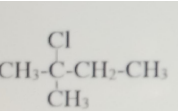
- A.3-chloro-3-methylbutane
- B.2,2,-dichloro-3-methylbutane
- C.3-methylchlorobutane
- D.2-chloro-2-methylbutane
Show answerHide answer
Answer: D 2-chloro-2-methylbutane
- 30.The pollutant usually presents in a city which generates its electricity from coal?
- A.fog
- B.carbon(ii)oxide
- C.smog
- D.sulphur(iv)oxide
Show answerHide answer
Answer: D sulphur(iv)oxide
- 31.The reactions below represent neutralization reaction, in which of them is the value of ΔH highest?
- A.CH \(_3\) CH \(_2\) COOH + KOH → CH \(_3\) CH \(_2\) COOK + H \(_2\) O
- B.NH \(_4\) OH + HCL → NH \(_4\) + H \(_2\) O
- C.NaOH + HCL → NaCL + H \(_2\) O
- D.CH \(_3\) COOH + NaOH → CH \(_3\) COONa + H \(_2\) O
Show answerHide answer
Answer: C NaOH + HCL → NaCL + H \(_2\) O
- 32.The sub-atomic particles located in the nucleus of an atom are?
- A.neutron and proton
- B.proton and electron
- C.proton and ions
- D.neutron and electron
Show answerHide answer
Answer: A neutron and proton
- 33.The sulphide that is commonly used in coating electric fluorescent tubes is?
- A.iron(ii)Sulphide
- B.tin(ii)sulphide
- C.Zinc Sulphide
- D.lead(iv) Sulphide
Show answerHide answer
Answer: C Zinc Sulphide
- 34.Using the metal activity series, the metal that can liberate hydrogen gas from steam is?
- A.iron
- B.copper
- C.tin
- D.lead
Show answerHide answer
Answer: A iron
- 35.What volume of (dm \(^3\) ) of water will be added to 10dm \(^3\) of 2.0 mol/dm \(^3\) HCL acid solution to give a final solution of 0.5 mol/dm \(^3\) ?
- A.30
- B.40
- C.20
- D.50
Show answerHide answer
Answer: A 30
- 36.When heat is absorbed during a chemical reaction, the reaction is said to be
- A.thermodynamic
- B.exothermic
- C.isothermal
- D.endothermic
Show answerHide answer
Answer: D endothermic
- 37.Which of the following best represent solid gas mixture?
- A.milk
- B.kerosene
- C.soil
- D.smoke
Show answerHide answer
Answer: B kerosene
- 38.Wrought iron is obtained by heating cast iron in a furnace with?
- A.magnetite
- B.haematite
- C.carbon(ii)oxide
- D.calcium trioxosilicate(iv)
Show answerHide answer
Answer: D calcium trioxosilicate(iv)
- 39.Zn + 2HCL → ZnCl \(_2\) + H \(_2\) What happens to zinc in the above reaction?
- A.oxidized
- B.a reactant
- C.reduced
- D.a metal
Show answerHide answer
Answer: A oxidized
Printing is turned off here to protect the question bank. Get the SmarTest app to study offline.
More free Chemistry papers
JAMB Chemistry 1978–2020 is in the app
The latest five years of each paper are free here. The SmarTest app has every year we hold, a worked explanation for each answer, and timed mock exams. It works offline.
Android, Windows, Mac and Linux