Chemistry past questions: JAMB UTME 2024
137 objective questions, with answers. Free to read and practise.
Sit this paper
137 questions, one at a time, marked as you go or at the end. No account needed.
- 1.\(^{14}_7\) N + X → \(^{14}_6\) C + \(^1_1\) P In the reaction above, X is
- A.a proton
- B.an alpha particle
- C.a beta particle
- D.a neutron
Show answerHide answer
Answer: D a neutron
- 2.\(^{238}_{92}\) U + \(^1_0\) n → \(^{239}_{92}\) U The process above produces
- A.atomic mutation
- B.a radioactive isotope
- C.other neutrons
- D.radiations
Show answerHide answer
Answer: B a radioactive isotope
- 3.From the table above, which of these two compounds can form functional group isomers?
COMPOUND S T U V W FORMULA ROR' RCOOH' RCOR' ROH' RCOOR' - A.S and T
- B.T and U
- C.S and V
- D.T and V
Show answerHide answer
Answer: A S and T
- 4.127g of sodium chloride was dissolved in 1.0dm \(^3\) of distilled water at 25 \(^0\) C . Determine the solubility in moldm \(^{-3}\) of sodium chloride at that temperature. [Na = 23, Cl = 35.5]
- A.1.0
- B.2.0
- C.2.2
- D.4.1
Show answerHide answer
Answer: C 2.2
- 5.25.0g of potassium chloride were dissolved in 80g of distilled water at 30 \(^0\) C. Calculate the solubility of the solute in mol dm \(^3\) . [K =39, Cl = 35.5]
- A.3.9 moldm \(^3\)
- B.4.6 moldm \(^3\)
- C.4.0 moldm \(^3\)
- D.4.2 moldm \(^3\)
Show answerHide answer
Answer: D 4.2 moldm \(^3\)
- 6.A factor that does not affect the rate of a chemical reaction is
- A.surface area
- B.temperature
- C.volume
- D.catalyst
Show answerHide answer
Answer: B temperature
- 7.A gas that turns lime water milky is likely to be from
- A.Trioxocarbonate(IV)
- B.Chloride
- C.Trioxonitrate(V)
- D.Tetraoxosulphate(VI)
Show answerHide answer
Answer: A Trioxocarbonate(IV)
- 8.A gas when mixed with oxygen, it produces a very hot and early controllable flame. What is the name of the flame and where is it used?
- A.Acetylene flame; miners' lamb
- B.Oxy-ethylene ; hunters' torch
- C.Oxy-ethylene flame; miners' lamb
- D.Oxy-ethylene flame ; cutting and welding metals
Show answerHide answer
Answer: D Oxy-ethylene flame ; cutting and welding metals
- 9.A liquid hydrocarbon obtained from fractional distillation of coal tar that is used in the pharmaceutical industry is
- A.xylene
- B.benzene
- C.hexane
- D.Toluene
Show answerHide answer
Answer: B benzene
- 10.A major effect of oil pollution in coastal water is
- A.destruction of aquatic life
- B.nitrification of the water body
- C.detoxification of water
- D.disinfection of the water body
Show answerHide answer
Answer: C detoxification of water
- 11.A radioactive element of mass 1g has half-life of 2 minutes, what fraction of the substance would have disintegrated after 10 minutes?
- A.1/4
- B.1/8
- C.1/16
- D.1/32
Show answerHide answer
Answer: D 1/32
- 12.A type of isomerism that ClCH=CHCl can exhibit is
- A.chain
- B.positional
- C.functional group
- D.optical
Show answerHide answer
Answer: B positional
- 13.A typical chemical reaction will be spontaneous if
- A.enthalpy change is negative
- B.free energy change is greater than one
- C.entropy change is zero
- D.enthalpy and free energy change are equal
Show answerHide answer
Answer: A enthalpy change is negative
- 14.After breathing in a test tube that contains acidified K \(_2\) Cr \(_2\) O \(_7\) , a man noticed the change in the colour of K \(_2\) Cr \(_2\) O \(_7\) from orange to green. This suggests the presence of
- A.alkanone
- B.alkanal
- C.alkanol
- D.alkanoic acid
Show answerHide answer
Answer: C alkanol
- 15.Alkanoates are naturally found in
- A.lipids
- B.vitamins
- C.proteins
- D.rubbers
Show answerHide answer
Answer: A lipids
- 16.Alkylation of benzene is catalyzed by
- A.palladium
- B.nickel
- C.sunlight
- D.aluminium chloride
Show answerHide answer
Answer: D aluminium chloride
- 17.An example of a compound that is acidic in solution is
- A.H \(_3\) PO \(_4\)
- B.NH \(_4\) Cl
- C.Na \(_2\) CO \(_3\)
- D.MgCl \(_2\)
Show answerHide answer
Answer: B NH \(_4\) Cl
- 18.An example of a physical change is
- A.exposing sodium metal to air
- B.boiling of water
- C.dissolving calcium metal in water
- D.burning of kerosene
Show answerHide answer
Answer: B boiling of water
- 19.An example of a substance that does not change directly from solid to gas when heated is
- A.NH \(_4\) Cl \((_s\) )
- B.I \(_2\) \((_s\) )
- C.CaCO \(_3\) \((_s\) )
- D.S \(_8\) \((_s\) )
Show answerHide answer
Answer: C CaCO \(_3\) \((_s\) )
- 20.An example of an amphoteric oxide is
- A.P \(_4\) O \(_{10}\)
- B.Al \(_2\) O \(_3\)
- C.CuO
- D.K \(_2\) O
Show answerHide answer
Answer: B Al \(_2\) O \(_3\)
- 21.An example of highly unsaturated hydrocarbon is
- A.C \(_2\) H \(_2\)
- B.CH \(_4\)
- C.C \(_2\) H \(_4\)
- D.C \(_4\) H \(_{10}\)
Show answerHide answer
Answer: A C \(_2\) H \(_2\)
- 22.An organic compound contains 53.1% Carbon, 6.2% Hydrogen, 12.4% Nitrogen, and 28.3% Oxygen by mass. What is the molecular formula of the compound if its vapour density is 56.5? [ C =12, H = 1, N = 14, O = 16].
- A.C \(_5\) H \(_7\) NO \(_2\)
- B.C \(_5\) H \(_6\) NO \(_2\)
- C.C \(_3\) H \(_6\) NO \(_2\)
- D.C \(_3\) H \(_7\) NO \(_2\)
Show answerHide answer
Answer: A C \(_5\) H \(_7\) NO \(_2\)
- 23.An organic compound with general formula RCOR' is an
- A.alkanone
- B.alkanal
- C.alkanoate
- D.alkanoic acid
Show answerHide answer
Answer: A alkanone
- 24.An oxide of nitrogen that can rekindle a glowing splint is
- A.nitrogen(I)oxide
- B.nitrogen(II)oxide
- C.nitrogen(IV)oxide
- D.dinitrogen tetraoxide
Show answerHide answer
Answer: A nitrogen(I)oxide
- 25.Aqueous solution of sodium hydroxide can be used to test for the presence of : I. Ca \(^{2+}\) , II. Zn \(^{2+}\) , III. Cu \(^{2+}\)
- A.I only
- B.I and III
- C.I, II and III
- D.I and II only
Show answerHide answer
Answer: C I, II and III
- 26.At a given temperature and pressure, a gas X diffuses twice as fast as gas Y. It follows that
- A.Gas Y is two times as heavy as Gas X
- B.Gas Y is four times as heavy as Gas X
- C.Gas Y is monoatomic
- D.Gas X is diatomic
Show answerHide answer
Answer: D Gas X is diatomic
- 27.Benzene formed nitrobenzene at temperature of 60 \(^0\) C when it reacts with mixture of concentrated trioxonitrate(V) acid and concentrated
- A.phosphoric acid
- B.hydrochloric acid
- C.tetraoxosulphate(VI) acid
- D.hydrogen iodide
Show answerHide answer
Answer: C tetraoxosulphate(VI) acid
- 28.Biodegradable pollutants are not safe in water systems because they can cause
- A.air pollution
- B.soil degradation
- C.ill health
- D.greenhouse effect
Show answerHide answer
Answer: C ill health
- 29.Biuret test is a chemical test used for detecting the presence of
- A.carbohydrates
- B.proteins
- C.amines
- D.alkanoates
Show answerHide answer
Answer: B proteins
- 30.Boyle's law can be expressed mathematically as
- A.PV = K
- B.PV = RT
- C.V =KT
- D.\(\frac{V}{T}\) = K
Show answerHide answer
Answer: A PV = K
- 31.C \(_2\) H \(_{4(g)}\) + 3O \(_{2(g)}\) → 2CO \(_{2(g)}\) + 2H \(_2\) O \(_{(g)}\) The above equation represents the combustion of ethene.If 10cm \(^3\) of ethene is burnt in 50cm \(^3\) of oxygen, what would be the volume of oxygen that would remain at the end of the reaction?
- A.20cm \(^3\)
- B.40cm \(^3\)
- C.60cm \(^3\)
- D.50cm \(^3\)
Show answerHide answer
Answer: A 20cm \(^3\)
- 32.C \(_x\) H \(_y\) O + 5O \(_2\) → 4CO \(_2\) + 4H \(_2\) O C \(_x\) H \(_y\) O in the equation is
- A.CH \(_2\) O
- B.C \(_2\) H \(_6\) O
- C.CH \(_4\) O
- D.C \(_2\) H \(_4\) O
Show answerHide answer
Answer: D C \(_2\) H \(_4\) O
- 33.Calculate the mass of Magnesium that will be liberated from its salt by the same quantity of electricity that liberated 16.0 g of Silver. [Mg = 24.0, Ag = 108 ]
- A.3.65 g
- B.3.56 g
- C.1.87 g
- D.1.78 g
Show answerHide answer
Answer: D 1.78 g
- 34.Calculate the number of moles of Copper that will be deposited, if 2 Faraday of electricity is passed through the copper during the electrolysis of copper(II)tetraoxosulphate(VI) [1F = 96500C ]
- A.0.5 mole
- B.1.0 mole
- C.2.0 moles
- D.3.0 moles
Show answerHide answer
Answer: B 1.0 mole
- 35.CH \(_3\) -CH \(_2\) -OH and CH \(_3\) -O-CH \(_3\) The relationship between the two compounds above, is that they are
- A.allotropes
- B.isotopes
- C.isomers
- D.isobars
Show answerHide answer
Answer: C isomers
- 36.Concentrated sodium chloride solution is electrolyzed using mercury cathode and graphite anode. The products at the anode and the cathode respectively are
- A.hydrogen and chlorine
- B.chlorine and hydrogen
- C.chlorine and sodium
- D.sodium and chlorine
Show answerHide answer
Answer: C chlorine and sodium
- 37.CuO \(_s\) + H \(_2\) ( \(_g\) ) ⇌ Cu \(_s\) + H \(_2\) O( \(_g\) ) In the equation above, the effect of increased pressure on the equilibrium position is that
- A.the equilibrium is shifted to the left
- B.the equilibrium is shifted to the right
- C.there is no effect
- D.more H \(_2\) \((g\) ) is produced
Show answerHide answer
Answer: D more H \(_2\) \((g\) ) is produced
- 38.Determine the empirical formula of an oxide of sulphur containing 60% of oxygen [S = 32, O = 16 ]
- A.SO \(_3\)
- B.SO \(_2\)
- C.SO \(_4\)
- D.SO
Show answerHide answer
Answer: A SO \(_3\)
- 39.Determine the half-life of a first order reaction with constant 4.5 x 10 \(^{-3}\) sec \(^{-1}\) .
- A.154 s
- B.15.4 s
- C.1540 s
- D.1.54 s
Show answerHide answer
Answer: B 15.4 s
- 40.During the fractional distillation of crude oil, the fraction that distills at 200 - 250 \(^0\) C is
- A.bitumen
- B.diesel
- C.kerosene
- D.petrol
Show answerHide answer
Answer: C kerosene
- 41.Esterification reaction is analogous to
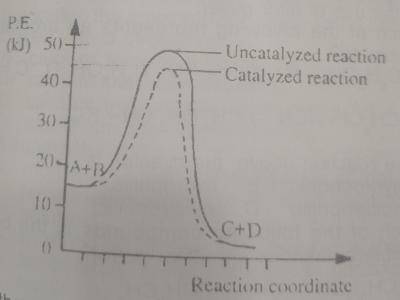
- A.oxidation reaction
- B.neutralization reaction
- C.condensation reaction
- D.hydrolysis reaction
Show answerHide answer
Answer: C condensation reaction
- 42.Fats and oils are esters of fatty organic acids combined with a trihydric alkanol commonly referred to as
- A.ethanol
- B.methanol
- C.glycol
- D.glycerol
Show answerHide answer
Answer: D glycerol
- 43.Fog is a colloid in which
- A.liquid particles is dispersed in a gas medium
- B.gas particles dispersed in a liquid medium
- C.solid particles dispersed in a gas medium
- D.gas particles dispersed in a solid medium
Show answerHide answer
Answer: C solid particles dispersed in a gas medium
- 44.For chemical reaction to be spontaneous, ∆G must be
- A.positive
- B.negative
- C.zero
- D.equal to the enthalpy change
Show answerHide answer
Answer: B negative
- 45.H \(_2\) S \(_{(g)}\) + Cl \(_2\) \(_{(g)}\) → 2HCl \(_{(g)}\) + S \(_{(s)}\) What is the change in oxidation state of sulphur from reactant to product?
- A.-3 to -1
- B.-3 to 1
- C.-2 to 0
- D.-1 to 0
Show answerHide answer
Answer: C -2 to 0
- 46.H \(_2\) SO \(_4\) C \(_2\) H \(_5\) OH → C \(_2\) H \(_4\) 170 \(^0\) C The reaction above illustrates
- A.oxidation
- B.esterification
- C.dehydration
- D.polymerization
Show answerHide answer
Answer: C dehydration
- 47.Heat of solution involves two steps that is accompanied by heat change. The energies involved in this steps are
- A.lattice energy and hydration energy
- B.lattice energy and ionic energy
- C.Heat energy and lattice energy
- D.hydration energy and heat energy
Show answerHide answer
Answer: D hydration energy and heat energy
- 48.How many isomers has the organic compound represented by the formula C \(_3\) H \(_8\) O ?
- A.2
- B.3
- C.4
- D.5
Show answerHide answer
Answer: B 3
- 49.How many moles of CO \(_2\) are produced when ethanol is burnt with 6g of oxygen
- A.0.125
- B.0.250
- C.0.375
- D.0.750
Show answerHide answer
Answer: A 0.125
- 50.How much of 5g of radioactive element whose half life is 50days remains after 200days?
- A.2.50 g
- B.1.25 g
- C.0.63 g
- D.0.31 g
Show answerHide answer
Answer: D 0.31 g
- 51.Hydrochloric acid is not suitable in the preparation of ethanoic acid because it
- A.is too acidic
- B.is too volatile
- C.can attack cork and rubber used as containers
- D.turns blue litmus red
Show answerHide answer
Answer: B is too volatile
- 52.Hydrochloric acid is regarded as a strong acid because it
- A.ionizes partially
- B.ionizes completely
- C.is a mineral acid
- D.reacts with a base
Show answerHide answer
Answer: B ionizes completely
- 53.Hydrogen chloride gas and ammonia can be used to demonstrate the fountain experiment because they are
- A.light
- B.volatile
- C.very soluble in water
- D.heavy gases
Show answerHide answer
Answer: C very soluble in water
- 54.If 11.0g of a gas occupies 5.6 dm \(^3\) at s.t.p., calculate its vapour density (1 mole of a gas occupies 22.4 dm \(^3\) ).
- A.22
- B.44
- C.66
- D.88
Show answerHide answer
Answer: A 22
- 55.If a salt weighs 2g and upon exposure to the atmosphere weighs 1.5g, this is as a result of
- A.hygroscopy
- B.effervescence
- C.efflorescence
- D.deliquescence
Show answerHide answer
Answer: B effervescence
- 56.If a stable neutral atom has a mass number of 31, the number of electrons and neutrons respectively are
- A.15 and 16
- B.16 and 31
- C.15 and 31
- D.16 and 15
Show answerHide answer
Answer: A 15 and 16
- 57.If the solubility of KNO \(_3\) at 30 \(^0\) C is 3.10 mol/dm \(^3\) a solution containing 303g/dm \(^3\) KNO \(_3\) is likely to be
- A.saturated
- B.unsaturated
- C.supersaturated
- D.at saturation point
Show answerHide answer
Answer: B unsaturated
- 58.In a chemical reaction, surface area of reactants can affect
- A.CaCO \(_3\) + 2HCl → CaCl \(_2\) + H \(_2\) O + CO \(_2\)
- B.MgCl \(_2\) + H \(_2\) SO \(_4\) → MgSO \(_4\) + 2HCl
- C.H \(_2\) + Cl \(_2\) → 2HCl
- D.NaOH + HCl → NaCl + H \(_2\) O
Show answerHide answer
Answer: A CaCO \(_3\) + 2HCl → CaCl \(_2\) + H \(_2\) O + CO \(_2\)
- 59.In contact process, the catalyst used in the conversion of sulphur(IV)oxide to sulphur(VI) oxide is
- A.nickel
- B.platinum
- C.vanadium(V)oxide
- D.magnesium(IV)oxide
Show answerHide answer
Answer: A nickel
- 60.In the conductance of aqueous CuSO \(_4\) solution, the current carriers are the
- A.mobile electrons
- B.metallic ions
- C.hydrated ions
- D.hydrated electrons
Show answerHide answer
Answer: C hydrated ions
- 61.In the extraction of Aluminium, the silica impurity is removed by
- A.electrolysis
- B.filtration
- C.reaction with H \(_2\) SO \(_4\)
- D.precipitation
Show answerHide answer
Answer: B filtration
- 62.In the graph above, y represents
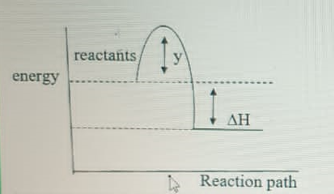
- A.endothermic reaction
- B.activation energy
- C.exothermic reaction
- D.ionization energy
Show answerHide answer
Answer: B activation energy
- 63.In the treatment of water for municipal supply, chlorine is used to
- A.prevent tooth decay
- B.prevent goitre
- C.kill germs
- D.remove colour or odour
Show answerHide answer
Answer: C kill germs
- 64.Kerosene is used as solvent for
- A.Paints
- B.Sulphur
- C.Gums
- D.Fats
Show answerHide answer
Answer: A Paints
- 65.Na \(_2\) X ⇌ 2Na \(^+\) + X \(^{2-}\) The bond between Na and X is likely to be
- A.covalent
- B.dative
- C.ionic
- D.metallic
Show answerHide answer
Answer: C ionic
- 66.Nitrogen obtained from air is not absolutely pure because it contains the following except
- A.oxygen
- B.carbon (IV)oxide
- C.inert gases
- D.water vapour
Show answerHide answer
Answer: B carbon (IV)oxide
- 67.One of the following is not a water pollutant?
- A.Inorganic fertilizers
- B.Warm water affluent
- C.Oxygen gas
- D.Biodegradable waste
Show answerHide answer
Answer: C Oxygen gas
- 68.Rust on the surface of a metal sheet contains
- A.hydrated iron(II)oxide
- B.hydrated iron(III)oxide
- C.iron(III)hydroxide
- D.iron(III) trioxocarbonate(IV)
Show answerHide answer
Answer: B hydrated iron(III)oxide
- 69.Scandium is not regarded as a transition metal because its ion has
- A.no electron in the d-orbital
- B.a partially filled d-orbitals
- C.a completely filled 4S orbital
- D.a partially filled 4S orbital
Show answerHide answer
Answer: B a partially filled d-orbitals
- 70.Silver and Gold are metals found as free uncombined elements in the earth's crust, which makes them to be referred to as
- A.corrosive metals
- B.reactive metals
- C.natural metals
- D.noble metals
Show answerHide answer
Answer: D noble metals
- 71.Solubility curve is a plot of solubility against
- A.temperature
- B.pressure
- C.volume
- D.concentrate
Show answerHide answer
Answer: A temperature
- 72.Strong acids can be distinguished from weak acids by any of the following methods, EXCEPT
- A.Conductivity measurement
- B.The use of litmus paper
- C.Measurement of pH
- D.Measurement of heat of reaction
Show answerHide answer
Answer: A Conductivity measurement
- 73.Sulphur(IV)oxide can be used as a
- A.coating agent
- B.dehydrating agent
- C.refrigerant
- D.drying agent
Show answerHide answer
Answer: C refrigerant
- 74.The amount of Faraday required to discharge 4.5 moles of Al \(^{3+}\) is
- A.13.5
- B.4.5
- C.7.5
- D.1.5
Show answerHide answer
Answer: A 13.5
- 75.The amount of water a substance chemically combined with is called water of
- A.dehydration
- B.solution
- C.hydration
- D.crystallization
Show answerHide answer
Answer: D crystallization
- 76.The basicity of tetraoxophosphate(V) acid is
- A.1
- B.4
- C.2
- D.3
Show answerHide answer
Answer: D 3
- 77.The chemical formula for potassiumhexacyanoferrate(II) is
- A.[Fe(CN) \(_6\) ] \(^{4-}\)
- B.K \(_3\) Fe(CN) \(_6\)
- C.Fe(CN) \(_6\)
- D.K \(_4\) Fe(CN) \(_6\)
Show answerHide answer
Answer: D K \(_4\) Fe(CN) \(_6\)
- 78.The combustion of candle under limited supply of air forms
- A.water and CO \(_2\)
- B.water and CO
- C.soot and CO
- D.soot and CO \(_2\)
Show answerHide answer
Answer: C soot and CO
- 79.The composition of alloy permalloy is iron and
- A.copper
- B.nickel
- C.lead
- D.magnesium
Show answerHide answer
Answer: A copper
- 80.The compound of Copper used as a fungicide is
- A.CuCO \(_3\)
- B.Cu(NO \(_3\) ) \(_2\)
- C.CuSO \(_4\)
- D.CuCl \(_2\)
Show answerHide answer
Answer: C CuSO \(_4\)
- 81.The constituent of petroleum fraction used in surfacing road is
- A.petrol
- B.diesel
- C.lubricating oil
- D.bitumen
Show answerHide answer
Answer: D bitumen
- 82.The constituents of Alnico are Aluminium, Nickel and
- A.Mg
- B.Co
- C.Mn
- D.Cu
Show answerHide answer
Answer: C Mn
- 83.The difference in molecular mass between an alkene and alkyne with six carbon per mole is
- A.10
- B.12
- C.2
- D.14
Show answerHide answer
Answer: C 2
- 84.The electronic configuration of an atom of Nitrogen is 1s \(^2\) 2s \(^2\) 2p \(^1_x\) 2p \(^1_y\) 2p \(^1_z\) because the atom is
- A.in an excited state
- B.undergoing energy changes
- C.unstable and ready to combine with another
- D.simply obeying rules governing electron configuration
Show answerHide answer
Answer: D simply obeying rules governing electron configuration
- 85.The element which can combine with oxygen to form an acid anhydride of the form XO \(_2\) is
- A.phosphorus
- B.Chlorine
- C.fluorine
- D.sulphur
Show answerHide answer
Answer: D sulphur
- 86.The empirical formula of an organic liquid hydrocarbon is XY. If the relative molar masses of X and Y are 72 and 6 respectively, it's vapour density is likely to be
- A.33
- B.66
- C.39
- D.78
Show answerHide answer
Answer: C 39
- 87.The general molecular formula C \(_n\) H \(_{2n-2}\) represents that of an
- A.alkyne
- B.alkene
- C.alkane
- D.alkanal
Show answerHide answer
Answer: A alkyne
- 88.The group VIII elements are the inert gases because they
- A.have lone pair of electrons on their valence shells
- B.all have completely filled valence shells
- C.are all solids
- D.are all polyatomic molecules
Show answerHide answer
Answer: B all have completely filled valence shells
- 89.The highest isotope of hydrogen is
- A.Deuterium
- B.protium
- C.tritium
- D.positron
Show answerHide answer
Answer: C tritium
- 90.The hybridization scheme in ethyne is
- A.sp
- B.sp \(^3\)
- C.sp \(^2\) d
- D.sp \(^2\) s
Show answerHide answer
Answer: A sp
- 91.The indicator used in a titration between strong acid and weak base is
- A.methyl orange
- B.phenolphthalein
- C.bromothymol blue
- D.methyl red
Show answerHide answer
Answer: A methyl orange
- 92.The ions responsible for permanent hardness in water are sulphates of
- A.Fe \(^{3+}\) and Mg \(^{2+}\)
- B.Ca \(^{2+}\) and Mg \(^{2+}\)
- C.Fe \(^{2+}\) and Fe \(^{3+}\)
- D.Na \(^{+}\) and Ca \(^{2+}\)
Show answerHide answer
Answer: B Ca \(^{2+}\) and Mg \(^{2+}\)
- 93.The IUPAC name of the compound above is
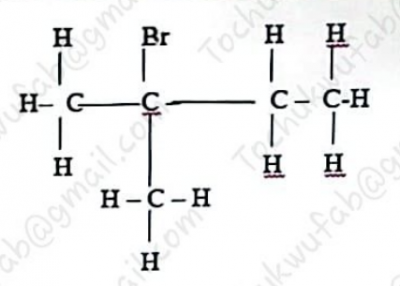
- A.3-methyl, 3-bromo butane
- B.2-methyl, 2-bromo butane
- C.2-bromo, 2-methyl butane
- D.3-bromo, 3-methyl butane
Show answerHide answer
Answer: C 2-bromo, 2-methyl butane
- 94.The IUPAC Nomenclature of CH \(_3\) CH \(_2\) C(CH \(_3\) )=C(CH \(_3\) ) \(_2\) for the compound is
- A.2,3-dimethylpentene
- B.2,3-dimethylpent-2-ene
- C.3,4-dimethylpent-3-ene
- D.3,4-dimethylpentene
Show answerHide answer
Answer: B 2,3-dimethylpent-2-ene
- 95.The IUPAC nomenclature of the complex K \(_4\) Fe(CN) \(_6\) is
- A.potassium hexacyanoferrate(II)
- B.potassium hexacyanoferrate(III)
- C.potassium hexacyanoferrate(IV)
- D.potassium hexacyanoferrate(VI)
Show answerHide answer
Answer: A potassium hexacyanoferrate(II)
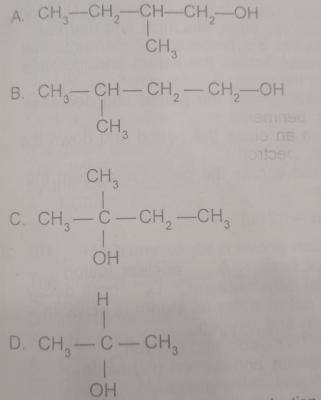
- 96.The IUPAC nomenclature of the compound above is
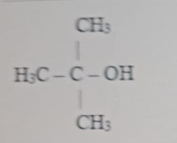
- A.propan-1-ol
- B.butan-1-ol
- C.2-methyl propan-1-ol
- D.2-methyl propan-2-ol
Show answerHide answer
Answer: C 2-methyl propan-1-ol
- 97.The law which states that a pure chemical compound, no matter how it is made, will be made up of the same elements contained in the same proportion by mass is
- A.law of conservation of masses
- B.law of definite proportion
- C.law of multiple proportion
- D.law of reciprocal proportion
Show answerHide answer
Answer: B law of definite proportion
- 98.The main constituent of water-glass is
- A.calcium trioxosilicate(IV)
- B.calcium trioxosulphate(IV)
- C.sodium trioxosulphate(IV)
- D.sodium trioxosilicate(IV)
Show answerHide answer
Answer: A calcium trioxosilicate(IV)
- 99.The molecular formular of a hydrocarbon with an empirical formula of CH \(_3\) and a molar mass of 30 is
- A.C \(_2\) H \(_4\)
- B.C \(_3\) H \(_3\)
- C.C \(_2\) H \(_6\)
- D.C \(_6\) H \(_6\)
Show answerHide answer
Answer: D C \(_6\) H \(_6\)
- 100.The number of geometrical isomers of butene are
- A.2
- B.3
- C.5
- D.4
Show answerHide answer
Answer: B 3
- 101.The number of molecules of helium gas contained in 11.5g of the gas is
- A.1.73 x 10 \(^{23}\)
- B.1.73 x 10 \(^{22}\)
- C.1.73 x 10 \(^{24}\)
- D.1.73 x 10 \(^{21}\)
Show answerHide answer
Answer: C 1.73 x 10 \(^{24}\)
- 102.The percentage of carbon(IV) oxide in air is
- A.0.01
- B.0.02
- C.0.05
- D.0.03
Show answerHide answer
Answer: B 0.02
- 103.The percentage of hydrogen in the sixth member of the class of the aliphatic alkanes is [H =1, C =12 ]
- A.41.34
- B.59.54
- C.16.28
- D.83.72
Show answerHide answer
Answer: C 16.28
- 104.The pH of a 0.001 mol dm \(^{-3}\) of H \(_2\) SO \(_4\) is [Log \(_{10}\) 2 = 0.3]
- A.2.7
- B.3.0
- C.3.3
- D.2.0
Show answerHide answer
Answer: A 2.7
- 105.The principle which states that no two electrons in the same orbitals of an atom have same value for all four quantum numbers is the
- A.Aufbau principle
- B.Hund's rule
- C.Pauli Exclusion principle
- D.Dilution principle
Show answerHide answer
Answer: C Pauli Exclusion principle
- 106.The product formed when ethyne is passed through a hot tube containing finely divided iron is
- A.polymeric
- B.saturated
- C.hydrated
- D.aromatic
Show answerHide answer
Answer: D aromatic
- 107.The quantity of electricity required to deposit 180g of Ag from a molten silver trioxonitrate(V) is [Ag = 108]
- A.1.08F
- B.3.30F
- C.1.67F
- D.1.80F
Show answerHide answer
Answer: A 1.08F
- 108.The reaction between alkanoic acids and alkanols in the presence of an acid catalyst is known as
- A.saponification
- B.dehydration
- C.esterification
- D.hydrolysis
Show answerHide answer
Answer: C esterification
- 109.The reaction of hydrogen and chlorine to produce hydrogen chloride gas is explosive in
- A.diffused light
- B.sunlight
- C.infrared light
- D.Raman light
Show answerHide answer
Answer: B sunlight
- 110.The salt formed when strong acid reacts with strong base is
- A.normal
- B.double
- C.complex
- D.basic
Show answerHide answer
Answer: A normal
- 111.The scientist that performed the experiment on discharged tubes that led to the discovery of the cathode rays as a sub-atomic particle is
- A.J.J Thomson
- B.Robert Millikan
- C.Ernest Rutherford
- D.Niels Bohr
Show answerHide answer
Answer: A J.J Thomson
- 112.The shape of ammonia molecule is
- A.V-Shaped or bent
- B.Tetrahedral
- C.co-plannar
- D.trigonal
Show answerHide answer
Answer: D trigonal
- 113.The shape of the molecule of Carbon(IV) oxide is
- A.tetrahedral
- B.pyramidal
- C.plannar
- D.linear
Show answerHide answer
Answer: D linear
- 114.The stability of atomic nucleus is determined by ratio of
- A.Neutron/electron
- B.Neutron/proton
- C.positron/neutron
- D.electron/proton
Show answerHide answer
Answer: B Neutron/proton
- 115.The substance that reacts with sodium to form alkali and changes white anhydrous copper(II) tetraoxosulphate (VI) to blue is
- A.base
- B.acid
- C.water
- D.solvent
Show answerHide answer
Answer: C water
- 116.The table above shows the formulae of some ions. In which of these compounds is the formula not correct?

- A.Aluminiumtetraoxosulphate(VI), Al \(_2\) (SO \(_4\) ) \(_3\)
- B.Calciumtrioxonitrate(V), Ca(NO \(_3\) ) \(_2\)
- C.Iron(III)bromide, Fe \(_3\) Br
- D.Potassiumsulphide, K \(_2\) S
Show answerHide answer
Answer: D Potassiumsulphide, K \(_2\) S
- 117.The term strong and weak acids is used to indicate the
- A.number of H \(^+\) released by an acid
- B.number of OH \(^-\) released by an acid
- C.extent of ionization of an acid
- D.strength of its action on substance
Show answerHide answer
Answer: C extent of ionization of an acid
- 118.The term that is not associated with petroleum industry is ?
- A.Cracking
- B.Saponification
- C.Polymerization
- D.Fermentation
Show answerHide answer
Answer: A Cracking
- 119.The Van der waals forces of attraction operates between
- A.atoms
- B.cations
- C.molecules
- D.anions
Show answerHide answer
Answer: C molecules
- 120.The volume in cm \(^3\) of a 0.12 moldm \(^{-3}\) HCl required to completely neutralize a 20cm \(^3\) of 0.20 moldm \(^{-3}\) of NaOH is
- A.12.00
- B.0.0012
- C.33.33
- D.2.40
Show answerHide answer
Answer: C 33.33
- 121.The volume occupied by 1 mole of an ideal gas at a temperature of 13 \(^0\) C and a pressure of 1.58 atm is [ R = 0.082 atm dm \(^3\) K \(^{-1}\) mol \(^{-1}\) ]
- A.14.84 dm \(^3\)
- B.14.84 cm \(^3\)
- C.0.64 dm \(^3\)
- D.0.64 cm \(^3\)
Show answerHide answer
Answer: A 14.84 dm \(^3\)
- 122.Water gas obtained from the gasification of coke is made up of
- A.Nitrogen and Carbon(II) oxide
- B.Nitrogen and Hydrogen
- C.Hydrogen and Carbon(II) oxide
- D.Carbon(II)oxide and Carbon(IV)oxide
Show answerHide answer
Answer: C Hydrogen and Carbon(II) oxide
- 123.What accounts for the low melting and boiling points of covalent molecules?
- A.They have weak intermolecular forces
- B.They are three-dimensional structures
- C.They have definite shapes
- D.They possess shared electron pairs
Show answerHide answer
Answer: A They have weak intermolecular forces
- 124.What is formed when metal reacts with acid to liberate gas?
- A.Salt
- B.Base
- C.Acid
- D.Liquid
Show answerHide answer
Answer: A Salt
- 125.What is the vapour density of 560cm \(^3\) of a gas that weighs 0.4g at s.t.p? [Molar Volume of gas at s.t.p = 22.4 dm \(^3\) ]
- A.6.0
- B.8.0
- C.16.0
- D.32.0
Show answerHide answer
Answer: B 8.0
- 126.What method is suitable for the separation of gases present in air?
- A.Catalytic cracking of liquid air
- B.Fractional distillation of liquid air
- C.Thermal decomposition of air
- D.Catalytic decomposition of air
Show answerHide answer
Answer: B Fractional distillation of liquid air
- 127.What would be the order of the electrolytic cell in an industry intending the production of silver plated spoons?
- A.Cathode is the spoon; anode is a silver rod; electrolyte is a soluble silver salt
- B.Cathode is a silver rod; anode is the spoon; electrolyte is a soluble silver salt
- C.Cathode is the spoon; anode is any rod; electrolyte is a soluble silver salt
- D.Cathode is any rod; anode is the spoon; electrolyte is a soluble salt
Show answerHide answer
Answer: A Cathode is the spoon; anode is a silver rod; electrolyte is a soluble silver salt
- 128.When a few drops of Millon reagents is added to egg-white solution in a test tube, the white precipitate changes to
- A.orange
- B.brick red
- C.reddish brown
- D.blue
Show answerHide answer
Answer: C reddish brown
- 129.When a specie undergoes oxidation, its
- A.oxidation number increases
- B.oxidation number decreases
- C.oxidation number remains constant
- D.acts as oxidizing agent
Show answerHide answer
Answer: B oxidation number decreases
- 130.When Calcium ethynide is decomposed by water, the gas produced is
- A.CO
- B.H \(_2\)
- C.C \(_2\) H \(_2\)
- D.CH \(_4\)
Show answerHide answer
Answer: C C \(_2\) H \(_2\)
- 131.When n = 3, the quantum number of an element is
- A.3
- B.9
- C.18
- D.21
Show answerHide answer
Answer: B 9
- 132.When Sulphur(IV)oxide is passed into solution of acidified tetraoxomanganate(VII), the colour changes from
- A.blue to green
- B.pink to yellow
- C.purple to colourless
- D.Orange to green
Show answerHide answer
Answer: C purple to colourless
- 133.When the subsidiary quantum numbers (l) equals 1, the shape of the orbital is
- A.spherical
- B.dumb-bell
- C.flat
- D.round
Show answerHide answer
Answer: B dumb-bell
- 134.Which of the following is an air pollutant?
- A.O \(_2\)
- B.CO
- C.H \(_2\) O \((_g\) )
- D.O \(_3\)
Show answerHide answer
Answer: B CO
- 135.Which of the following is used in forming slag in the blast furnace for the extraction of iron?
- A.Ca(CO \(_3\) ) \(_2\)
- B.Ca(OH) \(_2\)
- C.CaCO \(_3\)
- D.CaO
Show answerHide answer
Answer: C CaCO \(_3\)
- 136.Which of the following represents an order of increasing reactivity?
- A.Au < Cu < Sn < Fe < Ca
- B.Ca < Fe < Sn < Cu < Au
- C.Au < Cu < Fe < Sn < Ca
- D.Ca < Sn < Fe < Cu < Au
Show answerHide answer
Answer: A Au < Cu < Sn < Fe < Ca
- 137.Which of these is the most preferred separation technique for the isolation of solutes where the purity of the constituent is of utmost importance?
- A.sieving
- B.Distillation
- C.recrystallization
- D.Precipitation
Show answerHide answer
Answer: C recrystallization
Printing is turned off here to protect the question bank. Get the SmarTest app to study offline.
More free Chemistry papers
JAMB Chemistry 1978–2020 is in the app
The latest five years of each paper are free here. The SmarTest app has every year we hold, a worked explanation for each answer, and timed mock exams. It works offline.
Android, Windows, Mac and Linux