Chemistry past questions: WAEC SSCE 2022
48 objective questions, with answers. Free to read and practise.
Sit this paper
48 questions, one at a time, marked as you go or at the end. No account needed.
- 1.A colourless gas with a pungent smell is evolved when dilute hydrochloric acid is added to a sample of a salt. The gas evolved could turn
- A.acidified K \(_{2}\) Cr \(_{2}\) O \(_{7}\) solution colourless
- B.acidified KMnO \(_{4}\) solution colourless
- C.Fe(NO \(_{3}\) ) \(_{2}\) solution green
- D.Pb(NO \(_{3}\) ) \(_{2}\) paper black
Show answerHide answer
Answer: B acidified KMnO \(_{4}\) solution colourless
- 2.A hydrogen chloride gas reacted with oxygen gas to yield water and chlorine gas. The mole ratio of the hydrogen chloride gas to water is
- A.1:3
- B.2:1
- C.3:1
- D.4:1
Show answerHide answer
Answer: B 2:1
- 3.A white precipitate was formed when BaCl \(_{2(aq)}\) was added to an aqueous solution of a salt X. The precipitate dissolved in dilute HCl with rapid effervescence. Salt X is likely to contain
- A.SO \(_{4}\) \(^{2-}\) ions
- B.SO \(_{3}\) \(^{2-}\) ions
- C.NO \(_{3}\) - ions
- D.CO \(_{3}\) \(^{2-}\) - ions
Show answerHide answer
Answer: B SO \(_{3}\) \(^{2-}\) ions
- 4.Alkanols can be manufactured from alkenes by the initial reaction of alkenes with
- A.bromine in tetrachloromethane
- B.concentrated tetraoxosulphate(VI) acid
- C.aqueous potassium tetraoxomanganate(VII)
- D.sodium hydroxide solution
Show answerHide answer
Answer: B concentrated tetraoxosulphate(VI) acid
- 5.An oxide has the following properties. It I. is a white powder II. reacts with HCI. III. reacts with NaOH IV. is insoluble in water The oxide is
- A.alkaline
- B.amphoteric
- C.acidic
- D.neutral
Show answerHide answer
Answer: B amphoteric
- 6.Charcoal is used in the decolourization of sugar because of its
- A.absorption property.
- B.amorphous property.
- C.oxidizing property.
- D.adsorption property.
Show answerHide answer
Answer: D adsorption property.
- 7.Consider the following reaction equation N \(_{2}\) (g) + 3H \(_{2(g)}\) ⇌ 2NH3(g) ∆H = -92kJ Increasing the temperature of the reaction would
- A.shift the equilibrium to the right
- B.increase the yield of ammonia
- C.decrease the amount of hydrogen
- D.decrease the yield of ammonia
Show answerHide answer
Answer: D decrease the yield of ammonia
- 8.Consider the following reaction equation: CaO + SiO \(_{2}\) ------> CaSiO \(_{3}\) Silicon(IV) oxide is acting as
- A.a basic oxide
- B.a reducing agent
- C.an acidic oxide
- D.an oxidizing agent
Show answerHide answer
Answer: C an acidic oxide
- 9.Consider the following tableWhich of the substances is a liquid at room temperature and rapidly evaporates on exposure to air?
Substitute Meltig point / ºC Boiling point / ºC P - 78 -25 Q - 8 40 R - 6 150 S 44 280 - A.P
- B.Q
- C.R
- D.S
Show answerHide answer
Answer: B Q
- 10.Determine the quantity of electricity used when a current of 0.20 amperes is passed through an electrolytic cell for 60 minutes.
- A.12C
- B.120C
- C.360C
- D.720C
Show answerHide answer
Answer: D 720C
- 11.Electropositivity of elements across the periodic table normally
- A.remains constant down the group
- B.increases across the period
- C.decreases across the period
- D.decreases down the group
Show answerHide answer
Answer: C decreases across the period
- 12.Graphite is used as a dry lubricant due to the presence of
- A.mobile electrons
- B.free electrons
- C.octahedral structures
- D.layered structures
Show answerHide answer
Answer: D layered structures
- 13.If 5.0 g of marble reacts with 25.0 cm3 hydrochloric acid, which of the following combinations has the fastest reaction rate?
- A.Marble chips and 2.0 mol dm \(^{-3}\) HCl \(_{(aq)}\)
- B.Marble chips and 2.5 mol dm \(^{-3}\) HCl \(_{(aq)}\)
- C.Powdered marble and 2.5 mol dm \(^{-3}\) HCl \(_{(aq)}\)
- D.Powdered marble and 2.0 mol dm \(^{-3}\) HCl \(_{(aq)}\)
Show answerHide answer
Answer: C Powdered marble and 2.5 mol dm \(^{-3}\) HCl \(_{(aq)}\)
- 14.If 50 cm \(^{3}\) of a saturated solution of KNO \(_{3}\) at 40 °C contained 5.05 g of the salt, its solubility at the same temperature would be [KNO \(_{3}\) = 101]
- A.1.0 mol dm \(^{-3}\)
- B.1.5 mol dm \(^{-3}\)
- C.2.0 mol dm \(^{-3}\)
- D.5.0 mol dm \(^{-3}\)
Show answerHide answer
Answer: A 1.0 mol dm \(^{-3}\)
- 15.If 60 g of M combines with 24 g of oxygen, what would the empirical formula of the oxide be? ( molar mass of M = 120, O = 16)
- A.MO
- B.MO \(_{2}\)
- C.MO \(_{3}\)
- D.MO \(_{4}\)
Show answerHide answer
Answer: C MO \(_{3}\)
- 16.If the molar mass of X(HCO3) \(_{2}\) is 162 g mol \(^{-1}\) , determine the relative atomic mass of X. [H = 1.0, C = 12.0, 0 = 16.0]
- A.40
- B.48
- C.61
- D.101
Show answerHide answer
Answer: A 40
- 17.Increasing the temperature generally
- A.decreases the solubility of a solid in a liquid but increases the solubility of a gas in a liquid
- B.increases the solubility of a solid in a liquid but decreases the solubility of a gas in a liquid
- C.increases the solubility of both a solid and a gas in a liquid
- D.decreases the solubility of both a solid and a gas in a liquid
Show answerHide answer
Answer: B increases the solubility of a solid in a liquid but decreases the solubility of a gas in a liquid
- 18.Ionization energy increases across the period in the periodic table because
- A.atomic number increases
- B.effective nuclear charge increases
- C.mass number decreases
- D.screening effect decreases
Show answerHide answer
Answer: B effective nuclear charge increases
- 19.Oxochlorate(I) acid is used as a bleaching agent because it is
- A.a weak acid
- B.a reducing agent
- C.an oxidizing agent
- D.a strong acid
Show answerHide answer
Answer: C an oxidizing agent
- 20.The atom with the electron configuration 1s \(^{2}\) 2s \(^{2}\) 2p63s \(^{2}\) 3p \(^{6}\) 3d \(^{10}\) 4s \(^{2}\) 4p \(^{4}\) is in
- A.period 4, p- block
- B.period 3, p- block
- C.period 4, d- block
- D.period 3, d- block
Show answerHide answer
Answer: A period 4, p- block
- 21.The by-product of fermentation of sugar is
- A.carbon(IV) oxide
- B.ethanoic acid
- C.propanol
- D.propan-1, 2, 3- triol
Show answerHide answer
Answer: A carbon(IV) oxide
- 22.The cleansing effect of soap is low in acidic water because of
- A.the formation of unionized fatty acid
- B.increase in the pH of the soap molecules
- C.anti-biodegradable effect of hydrogen ions
- D.the hardness of the acidic water
Show answerHide answer
Answer: A the formation of unionized fatty acid
- 23.The first definition of an element was made by
- A.J. Dalton.
- B.A. Lavoisier.
- C.R. Boyle.
- D.J. J. Thompson.
Show answerHide answer
Answer: C R. Boyle.
- 24.The following compounds are condensation polymers except
- A.nylon
- B.protein
- C.starch
- D.polyethene
Show answerHide answer
Answer: D polyethene
- 25.The IUPAC name for CH \(_{3}\) CHCH \(_{3}\) CHCLCHCH \(_{3}\) CH \(_{2}\) CH \(_{3}\) is
- A.2, 4 - dimethyl - 3 - chlorohexane
- B.3, 5 - dimethyl - 4 - chlorohexane
- C.4 - chloro - 3, 5 - dirnethylhexane
- D.3 - chloro - 2, 4 - dimethylhexane
Show answerHide answer
Answer: D 3 - chloro - 2, 4 - dimethylhexane
- 26.The IUPAC name of the compound CH3CH(CH3)CHCH2 is

- A.2 - methyl but - 1 - ene
- B.2 - methyl but - 2 - ene
- C.3 - methyl but - 1 - ene
- D.3 - methyl but - 2 - ene
Show answerHide answer
Answer: C 3 - methyl but - 1 - ene
- 27.The maximum number of covalent bonds formed by nitrogen is
- A.1
- B.2
- C.3
- D.4
Show answerHide answer
Answer: D 4
- 28.The products of the electrolysis of dilute sodium chloride using carbon electrodes are Anode Cathode
- A.chlorine and sodium.
- B.oxygen and hydrogen.
- C.chlorine and hydrogen.
- D.hydrogen and oxygen.
Show answerHide answer
Answer: B oxygen and hydrogen.
- 29.What amount of electricity is required to deposit one mole of aluminium from a solution of AlCl3?
- A.One Faraday
- B.One ampere
- C.Three Faradays
- D.Three amperes
Show answerHide answer
Answer: C Three Faradays
- 30.What is the partial pressure of oxygen at s.t.p. in a gaseous mixture containing 100 cm3 of oxygen and 900 cm3 of nitrogen gas?
- A.1.0 atm
- B.0.1 atm
- C.9.0 atm
- D.0.9 atm
Show answerHide answer
Answer: B 0.1 atm
- 31.What is the percentage composition of carbon in Ca(HCO3) \(_{2}\) ? [ Ca = 40.0, 0= 16.0, C = 12.0, H= 1.0]
- A.22.2%
- B.14.8%
- C.7.4%
- D.3.7%
Show answerHide answer
Answer: B 14.8%
- 32.What number of moles of oxygen would exert a pressure of 10 atm at 320 K in an 8.2 dm \(^{3}\) cylinder? [R=0.082 atm dm \(^{-3}\) mol \(^{-1}\) K \(^{-1}\) ]
- A.0.32
- B.1.52
- C.3.13
- D.31.25
Show answerHide answer
Answer: C 3.13
- 33.When air in a syringe is compressed such that there is no change in temperature, the
- A.air liquefies
- B.pressure increases
- C.intermolecular space increases
- D.density decreases
Show answerHide answer
Answer: B pressure increases
- 34.Which of the following acids would form normal salt only?
- A.Tetraoxosulphate(VI) acid
- B.Trioxonitrate(V) acid
- C.Tetraoxophosphate(V) acid
- D.Trioxosulphate(IV) acid
Show answerHide answer
Answer: B Trioxonitrate(V) acid
- 35.Which of the following bond types is intermolecular?
- A.Covalent bond
- B.Hydrogen bond
- C.Ionic bond
- D.Metallic bond
Show answerHide answer
Answer: B Hydrogen bond
- 36.Which of the following compounds would react rapidly with bromine?
- A.Benzene
- B.Hexane
- C.Hexene
- D.Hexanol
Show answerHide answer
Answer: C Hexene
- 37.Which of the following elements would displace copper from a solution of copper ions?
- A.silver
- B.gold
- C.lead
- D.mercury
Show answerHide answer
Answer: C lead
- 38.Which of the following gases is alkaline?
- A.NO \(_{2}\)
- B.CO \(_{2}\)
- C.NH \(_{3}\)
- D.N \(_{2}\) O
Show answerHide answer
Answer: C NH \(_{3}\)
- 39.Which of the following oxides is amphoteric?
- A.Carbon(II) oxide
- B.Nitrogen(IV) oxide
- C.Lead(II) oxide
- D.Calcium oxide
Show answerHide answer
Answer: C Lead(II) oxide
- 40.Which of the following processes occur during fractional distillation of petroleum?
- A.Condensation and diffusion
- B.Diffusion and evaporation
- C.Diffusion and sublimation
- D.Evaporation and condensation
Show answerHide answer
Answer: D Evaporation and condensation
- 41.Which of the following properties indicate that an element is a metal. It I. reacts with oxygen to form an acidic oxide II. forms ionic chlorides III. has variable oxidation states IV. displaces hydrogen from dilute HCl
- A.I and III only
- B.I and II only
- C.II and IV only
- D.I, II, III and IV
Show answerHide answer
Answer: C II and IV only
- 42.Which of the following scientists formulated the law of conservation of mass?
- A.A. Lavoisier
- B.J. Dalton
- C.R. Boyle
- D.J. Proust
Show answerHide answer
Answer: A A. Lavoisier
- 43.Which of the following sketches is a graphical representation of Boyle's law?
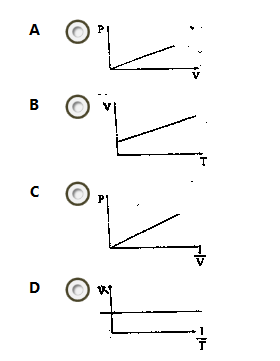
- A.A
- B.B
- C.C
- D.D
Show answerHide answer
Answer: C C
- 44.Which of the following statements about an equilibrium system is correct?
- A.Forward and backward reactions occur at the same rate
- B.The concentrations of reactants must equal that of the products
- C.The concentrations of, reactants and products can be changed by adding a catalyst,
- D.The concentrations of reactants and products are not affected by a change in temperature
Show answerHide answer
Answer: A Forward and backward reactions occur at the same rate
- 45.Which of the following statements about atoms of a metal is correct? They
- A.readily accept electrons
- B.are soft
- C.are held together by covalent bond
- D.are held together by a sea of electron cloud
Show answerHide answer
Answer: D are held together by a sea of electron cloud
- 46.Which of the following statements about liquids is/are true? I. Liquids maintain their volume at constant temperature. II. Liquids have fixed shape III. Liquids do not diffuse IV. Change in pressure affects volume of liquids
- A.I only
- B.IV only
- C.I and IV only
- D.II and III only
Show answerHide answer
Answer: A I only
- 47.Which of the following statements about the standard hydrogen electrode is not correct?
- A.The hydrogen gas is at a pressure of 1 atmosphere
- B.A solution containing 1 mol dm-3 of H+ (aq) ions is used
- C.A platinum electrode is used
- D.The temperature is kept at 20 °C
Show answerHide answer
Answer: D The temperature is kept at 20 °C
- 48.Which of the following sugars is a product of the condensation of monosaccharides?
- A.galactose
- B.maltose
- C.glucose
- D.fructose
Show answerHide answer
Answer: B maltose
Printing is turned off here to protect the question bank. Get the SmarTest app to study offline.
More free Chemistry papers
WAEC Chemistry 1985–2020 is in the app
The latest five years of each paper are free here. The SmarTest app has every year we hold, a worked explanation for each answer, and timed mock exams. It works offline.
Android, Windows, Mac and Linux