Chemistry past questions: WAEC SSCE 2021
48 objective questions, with answers. Free to read and practise.
Sit this paper
48 questions, one at a time, marked as you go or at the end. No account needed.
- 1.A coordinate covalent bond could be formed between?
- A.NH \(_{3}\) and PCl \(_{3}\)
- B.BCl \(_{3}\) and AlCl \(_{3}\)
- C.BCl \(_{3}\) and NH \(_{3}\)
- D.H \(^{+}\) and AlCl \(_{3}\)
Show answerHide answer
Answer: C BCl \(_{3}\) and NH \(_{3}\)
- 2.A molecular of phosphorus is
- A.diatomic
- B.triatomic
- C.tetraatomic
- D.monoatomic
Show answerHide answer
Answer: C tetraatomic
- 3.An element, Q, contains 69% of \(^{63}\) Q and 31% of \(^{65}\) Q. What is the relative atomic mass of Q?
- A.63.0
- B.63.6
- C.65.0
- D.69.0
Show answerHide answer
Answer: B 63.6
- 4.Cathodic protection of metals is based on
- A.standard electrode potential of hydrogen
- B.its electrical conductivity
- C.nature of oxides formed
- D.relative tendencies of oxidation
Show answerHide answer
Answer: D relative tendencies of oxidation
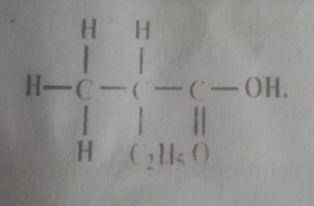
- 5.Consider the structure above How many carbon atoms does the parent chain contain?
- A.5
- B.4
- C.3
- D.2
Show answerHide answer
Answer: B 4
- 6.Electrovalent compounds normally ------------
- A.have low boiling points
- B.have mobile electrons
- C.conduct electricity in the solid state
- D.dissolve in polar solvent
Show answerHide answer
Answer: D dissolve in polar solvent
- 7.Elements with high ionization energies would-------
- A.lose electrons easily
- B.have large atomic radii
- C.have high effective nuclear charges
- D.have low atomic numbers
Show answerHide answer
Answer: C have high effective nuclear charges
- 8.How many coulombs of electricity would liberate 1.08g of Ag from a solution of silver salt? [Ag = 108.0; 1F = 96500 C]
- A.96500 C
- B.9650 C
- C.965 C
- D.9.65 C
Show answerHide answer
Answer: C 965 C
- 9.How many molecules of oxygen would occupy a volume of 2.24 cm \(^{3}\) at s.t.p? [Molar volume at s.t.p = 22,400 cm \(^{3}\) , Avogadro's number = 6.02 x 10 \(^{23}\) ]
- A.3.01 x 10 \(^{20}\)
- B.3.01 x 10 \(^{27}\)
- C.6.02 x 10 \(^{19}\)
- D.6.02 x 10 \(^{27}\)
Show answerHide answer
Answer: C 6.02 x 10 \(^{19}\)
- 10.If humid air is polluted by chlorine discharged, the air can be restored by sprinkling
- A.solid MnO \(_{2}\)
- B.acidified KMnO \(_{4}\)
- C.acidified FeSO \(_{4}\)
- D.saturated NaCl(aq)
Show answerHide answer
Answer: B acidified KMnO \(_{4}\)
- 11.Potassium trioxonitrate (V) can be obtained from its solution by----------
- A.distillation
- B.evapoartion
- C.crystallization
- D.filtration
Show answerHide answer
Answer: C crystallization
- 12.Protons and electrons are called fundamental particles because they----------
- A.are indivisible
- B.have different charges
- C.are the lightest particles
- D.are found in all matter
Show answerHide answer
Answer: D are found in all matter
- 13.Study the graphs below and use them to answer the question below [img: Open photo] Which of the following illustrates the variation of the rate of evolution of gas from a given length of magnesium ribbon (y-axis) with an increase in the concentration of the added (x-axis)?
- A.I
- B.II
- C.III
- D.IV
Show answerHide answer
Answer: A I
- 14.The 25°C evaporation of a 100 cm \(^{3}\) solution of K \(_{2}\) CO \(_{3}\) to dryness gave 14g of the salt. What is the solubility of K \(_{2}\) CO \(_{3}\) at 25°C? [K \(_{2}\) CO \(_{3}\) = 138]
- A.0.01 mol dm \(^{-3}\)
- B.0.101 mol dm \(^{-3}\)
- C.1.01 mol dm \(^{-3}\)
- D.10.0 mol dm \(^{-3}\)
Show answerHide answer
Answer: C 1.01 mol dm \(^{-3}\)
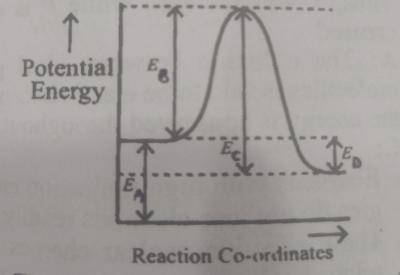
- 15.The activation energy of the reaction is
- A.E \(_{A}\)
- B.E \(_{B}\)
- C.E \(_{C}\)
- D.E \(_{D}\)
Show answerHide answer
Answer: C E \(_{C}\)
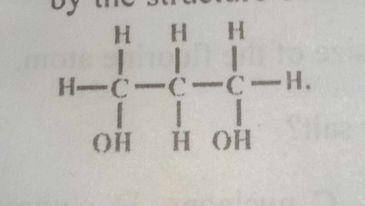
- 16.The alkanol represented by the structure above is
- A.primary and dihydric
- B.secondary and monohydric
- C.tertiary and dihydric
- D.secondary and dihydric
Show answerHide answer
Answer: A primary and dihydric
- 17.The basic property of salts used as drying agents is by?
- A.efforescence
- B.high melting point
- C.hygroscopy
- D.low solubility
Show answerHide answer
Answer: C hygroscopy
- 18.The Bohr model of the atom proposed the existence of?
- A.the nucleus
- B.electron shells
- C.nucleons
- D.neutrons
Show answerHide answer
Answer: B electron shells
- 19.The collision between ideal gas molecules are considered to be perfectly elastic because
- A.they collide without losing energy
- B.they move randomly in a straight line
- C.their average kinetic energy is variable
- D.the distance between them is large compared to their size
Show answerHide answer
Answer: A they collide without losing energy
- 20.The energy profile diagram illustrates-------------
- A.an endothermic reaction
- B.an exothermic reaction
- C.a spontaneous reaction
- D.a redox reaction
Show answerHide answer
Answer: B an exothermic reaction
- 21.The enthalpy change of the reaction is------------
- A.E \(_{A}\)
- B.E \(_{B}\)
- C.E \(_{C}\)
- D.E \(_{D}\)
Show answerHide answer
Answer: D E \(_{D}\)
- 22.The following ions have the same electron configuration except \(_{8}\) O, \(_{12}\) Mg, \(_{13}\) AI, \(_{17}\) CI
- A.CI \(^{-}\)
- B.O \(^{2-}\)
- C.Mg \(^{2+}\)
- D.AI \(^{3+}\)
Show answerHide answer
Answer: A CI \(^{-}\)
- 23.The formation of ethene from dehydration of ethanol can be described as-------
- A.an addition reaction
- B.an elimination reaction
- C.an oxidation reaction
- D.a substitution reaction
Show answerHide answer
Answer: B an elimination reaction
- 24.The hydrolysis of proteins by diluting mineral acids produces
- A.sucrose
- B.glucose
- C.amino acids
- D.fatty acids
Show answerHide answer
Answer: C amino acids
- 25.The isotopes of neon are represented by the symbols \(^{20}\) \(_{x}\) Ne, \(^{21}\) \(_{y}\) Ne, and \(^{22}\) \(_{z}\) Ne. The relationship between x, y, and z is?
- A.x > y > z
- B.x < y < z
- C.x = y= z
- D.x < z < y
Show answerHide answer
Answer: C x = y= z
- 26.The most common method of preparing insoluble salts is by
- A.filtration
- B.decomposition
- C.neutralization
- D.double decomposition
Show answerHide answer
Answer: D double decomposition
- 27.The ratio of carbon atoms of hydrogen atoms in a hydrocarbon is 1:2. If its molecular mass is 56, what is its molecular formula?
- A.C \(_{3}\) H \(_{6}\)
- B.C \(_{4}\) H \(_{8}\)
- C.C \(_{2}\) H \(_{4}\)
- D.CH \(_{2}\)
Show answerHide answer
Answer: B C \(_{4}\) H \(_{8}\)
- 28.The reactivity of fluorine is high because of
- A.its high electronegativity
- B.the small size of the fluorine atom
- C.the availability of d-orbitals
- D.the strong F-F bond
Show answerHide answer
Answer: A its high electronegativity
- 29.The region around the nucleus where electrons can be located is called?
- A.a spectra
- B.an orbital
- C.a quanta
- D.a field
Show answerHide answer
Answer: B an orbital
- 30.Under which conditions of pressure (p) and temperature (T) would the volume of an inflated ballon increase? When
- A.P and T are increased
- B.both T and P are decreased
- C.T is increased and P is decreased
- D.T is decreased and P is increased
Show answerHide answer
Answer: C T is increased and P is decreased
- 31.What is the concentration of a solution which contains 0.28g of potassium hydroxide in 100 cm \(^{3}\) of solution [KOH = 56]
- A.0.01 mol dm \(^{-3}\)
- B.0.05 mol dm \(^{-3}\)
- C.0.10 mol dm \(^{-3}\)
- D.0.50 mol dm \(^{-3}\)
Show answerHide answer
Answer: B 0.05 mol dm \(^{-3}\)
- 32.What is the empirical formula of a hydrocarbon containing 0.160 moles of carbon and 0.640 moles of hydrogen
- A.CH \(_{2}\)
- B.CH \(_{3}\)
- C.CH \(_{4}\)
- D.C \(_{2}\) H \(_{4}\)
Show answerHide answer
Answer: C CH \(_{4}\)
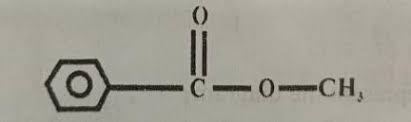
- 33.What is the relative molecular mass of the compound below? [img: What is the relative molecular mass of the compound below [H = 1.0; C = 12.0; O = 16.0] - SchoolNGR] [H = 1.0; C = 12.0; O = 16.0]
- A.137
- B.136
- C.64
- D.59
Show answerHide answer
Answer: B 136
- 34.What number of moles of oxygen would exert a pressure of 10 atm at 320 K in an 8.2 dm \(^{2}\) cylinder? [R = 0.082 atm dm \(^{3}\) mol \(^{-1}\) K \(^{-1}\) ]
- A.0.32
- B.1.56
- C.3.13
- D.31.25
Show answerHide answer
Answer: C 3.13
- 35.What would be observed when aqueous ammonia is added in drops and then in excess to a solution of copper(II) ions?
- A.blue precipitate is formed which is soluble in excess ammonia
- B.brick red precipitate is produced which is insoluble in excess ammonia
- C.white precipitate is formed which is excess in ammonia
- D.green precipitate is formed which is insoluble in excess ammonia
Show answerHide answer
Answer: A blue precipitate is formed which is soluble in excess ammonia
- 36.When CuSO \(_{4(aq)}\) is added to Pb(NO \(_{3}\) ) \(_{2(aq)}\) --------
- A.there would be no visible change
- B.a blue precipitate would be formed
- C.the resulting solution would become colourless
- D.a white precipitate would be formed
Show answerHide answer
Answer: D a white precipitate would be formed
- 37.Which of the following cell notations represent the diagram?
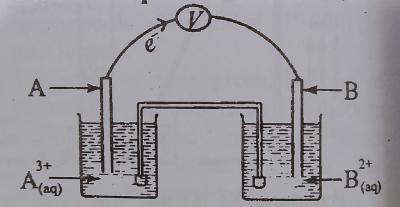
- A.B \(^{2+}\) /B/ /A/A \(^{3+}\)
- B.A \(^{3+}\) /A/ /B/B \(^{2+}\)
- C.B/B \(^{2+}\) / /A/ \(^{3+}\)
- D.A/A \(^{3+}\) / /B \(^{2+}\) /B
Show answerHide answer
Answer: D A/A \(^{3+}\) / /B \(^{2+}\) /B
- 38.Which of the following gasses is highly soluble in water at room temperature
- A.ammonia
- B.carbon (IV) oxide
- C.chlorine
- D.nitrogen
Show answerHide answer
Answer: A ammonia
- 39.Which of the following half reaction equations represent the reaction at the cathode
- A.A \(^{3+_{(aq)}}\) +3e \(^{-}\) \(\rightarrow\) A \(_{(s)}\)
- B.B \(^{2+_{(aq)}}\) +2e \(^{-}\) \(\rightarrow\) B \(_{(s)}\)
- C.A \(_{(s)}\) \(\rightarrow\) \(^{3+_{(aq)}}\) +3e \(^{-}\)
- D.B \(_{(s)}\) \(\rightarrow\) B \(^{2+_{(aq)}}\) + 2e \(^{-}\)
Show answerHide answer
Answer: B B \(^{2+_{(aq)}}\) +2e \(^{-}\) \(\rightarrow\) B \(_{(s)}\)
- 40.Which of the following oxide causes acid rain?
- A.CO
- B.NO
- C.H \(_{2}\) O \(_{2}\)
- D.NO \(_{2}\)
Show answerHide answer
Answer: D NO \(_{2}\)
- 41.Which of the following pairs of compounds would form a precipitate when their aqueous solutions are mixed?
- A.NaCl and KNO \(_{3}\)
- B.KCL and NaNO \(_{3}\)
- C.K \(_{2}\) SO \(_{4}\) and BaCl \(_{2}\)
- D.NH \(_{4}\) NO \(_{3}\) and CO \(_{3}\)
Show answerHide answer
Answer: C K \(_{2}\) SO \(_{4}\) and BaCl \(_{2}\)
- 42.Which of the following pairs of molecules form hydrogen bonds?
- A.C \(_{2}\) H \(_{5}\) OH and CH \(_{3}\) OH
- B.CH \(_{3}\) OH and H \(_{2}\)
- C.H \(_{2}\) S and CH \(_{4}\)
- D.NH \(_{3}\) and SO \(_{2}\)
Show answerHide answer
Answer: A C \(_{2}\) H \(_{5}\) OH and CH \(_{3}\) OH
- 43.Which of the following scientists discovered the electrons?
- A.Joseph J. Thompson
- B.James Chadwick
- C.Amedeo Avogadro
- D.Ernest Rutherford
Show answerHide answer
Answer: A Joseph J. Thompson
- 44.Which of the following statements about elements in Group VII is correct?
- A.Br \(_{2}\) will oxidize CI \(^{-}\)
- B.F \(_{2}\) has the least tendency to be reduced
- C.Cl \(_{2}\) will oxidize I \(^{-}\)
- D.l \(_{2}\) is a stronger oxidizing agent than F \(_{2}\)
Show answerHide answer
Answer: C Cl \(_{2}\) will oxidize I \(^{-}\)
- 45.Which of the following statements about Group VII elements is correct?
- A.they are present in the same physical state
- B.they are strong reducing agents
- C.their reactivity decreases down the group
- D.they exist as monoatomic molecules
Show answerHide answer
Answer: C their reactivity decreases down the group
- 46.Which of the following statements is correct about ionization energy? It
- A.decreases across the periods
- B.results in the formation of an anion
- C.causes Metalic nuclei to disintegrate
- D.decreases down the group
Show answerHide answer
Answer: D decreases down the group
- 47.Which of the graphs illustrates the variation of the pH of a given volume of strong acid solution (y-axis) with the volume of strong base titrated against its (x-axis)?
- A.I
- B.II
- C.III
- D.IV
Show answerHide answer
Answer: A I
- 48.Which of the graphs illustrates the variation of the solubility of a salt in water (y-axis), with an increase in temperature (x-axis) if the dissolution process is exothermic?
- A.I
- B.II
- C.III
- D.IV
Show answerHide answer
Answer: D IV
Printing is turned off here to protect the question bank. Get the SmarTest app to study offline.
More free Chemistry papers
WAEC Chemistry 1985–2020 is in the app
The latest five years of each paper are free here. The SmarTest app has every year we hold, a worked explanation for each answer, and timed mock exams. It works offline.
Android, Windows, Mac and Linux