Biology past questions: NECO SSCE 2005
44 objective questions, with answers. Free to read and practise.
Sit this paper
44 questions, one at a time, marked as you go or at the end. No account needed.
- 1.A waterlogged habitat with low light penetration and very low quantity of dissolved oxygen best describes a/an habitat
- A.estuarine
- B.marine
- C.sahel savanna
- D.swampy
- E.tropical rainforest
Show answerHide answer
Answer: D swampy
- 2.All these statements are correct about a vein EXCEPT that it
- A.carries blood to the heart
- B.contains blood at low pressure
- C.has no valve
- D.possesses fairly thick walls
- E.usually carries deoxygenated blood
Show answerHide answer
Answer: C has no valve
- 3.An example of a carnivorous plant is
- A.cassytha
- B.lichen
- C.mucor
- D.mushroom
- E.sundew
Show answerHide answer
Answer: E sundew
- 4.An example of a natural source of light energy is
- A.electricity
- B.food
- C.heat
- D.petrol
- E.sun
Show answerHide answer
Answer: E sun
- 5.An organism with identical allelic genes is described as
- A.dihybrid
- B.heterozygous
- C.homozygous
- D.monohybrid
- E.recessive
Show answerHide answer
Answer: C homozygous
- 6.Autotrophs include all the following EXCEPT
- A.chemosynthetic bacteria
- B.diatoms
- C.green plants
- D.phytoplankton
- E.zooplankton
Show answerHide answer
Answer: E zooplankton
- 7.Birds excrete nitrogenous wastes in form of
- A.ammonia
- B.sweat
- C.urea
- D.uric acid
- E.urine
Show answerHide answer
Answer: D uric acid
- 8.Blood carrying digested food from the small intestine flows into the liver via the
- A.hepatic portal vein
- B.hepatic vein
- C.hepatic artery
- D.mesenteric artery
- E.renal vein
Show answerHide answer
Answer: A hepatic portal vein
- 9.Deficiency of calcium in a child's diet causes
- A.cretinism
- B.goiter
- C.kwashiorkor
- D.rickets
- E.scurvy
Show answerHide answer
Answer: D rickets
- 10.Dry, horny scales in reptiles help them to
- A.carryout gaseous exchange
- B.escape from predator
- C.facilitate movement
- D.look for mating partners
- E.prevent water loss
Show answerHide answer
Answer: E prevent water loss
- 11.In a test for reducing sugar, the food substance is usually warmed with
- A.Benedict's solution
- B.Millon's reagent
- C.Sodium hydroxide
- D.Sudan III
- E.1% copper II sulphate solution
Show answerHide answer
Answer: A Benedict's solution
- 12.In which region of the body is the diagram illustrated found?
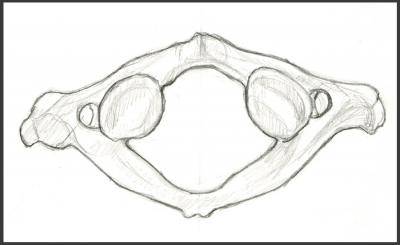
- A.Abdominal
- B.Chest
- C.Neck
- D.Tail
- E.Waist
Show answerHide answer
Answer: C Neck
- 13.ln mammals, fertilization takes place in the
- A.ovary
- B.oviduct
- C.uterus
- D.vagina
- E.vulva
Show answerHide answer
Answer: B oviduct
- 14.ln the process of succession, a climax community is established when
- A.a stable community is achieved
- B.the colonizers accommodate the new corners
- C.the colonizers are wiped out
- D.the first inhabitants settle down
- E.the new corners dominate the original inhabitants
Show answerHide answer
Answer: A a stable community is achieved
- 15.Poor growth and yellowing of leaves in plants is due to deficiency of
- A.boron
- B.calcium
- C.copper
- D.iron
- E.phosphorus
Show answerHide answer
Answer: D iron
- 16.The association between a tapeworm and an infected mammal illustrates
- A.commensalism
- B.parasitism
- C.predation
- D.saprophytism
- E.symbiosis
Show answerHide answer
Answer: B parasitism
- 17.The following are ways of caring for the mammalian skin EXCEPT
- A.eating balanced diet
- B.exposing the skin to adequate sunlight
- C.using skin toning creams
- D.using moisturising creams to prevent drying
- E.washing the skin with clean water and soap
Show answerHide answer
Answer: C using skin toning creams
- 18.The following can increase crop production EXCEPT
- A.erosion control
- B.fertilizer application
- C.mechanization
- D.monocropping
- E.pest control
Show answerHide answer
Answer: D monocropping
- 19.The following parts of the ear are involved in hearing EXCEPT
- A.auditory meatus
- B.cochlea
- C.eardrum
- D.eustachian tube
- E.ossicles
Show answerHide answer
Answer: D eustachian tube
- 20.The gland that secretes the hormone glucagon is ... gland
- A.adrenal
- B.endocrine
- C.pancreas
- D.pituitary
- E.thyroid
Show answerHide answer
Answer: C pancreas
- 21.The medium of transportation in higher plants is
- A.cell sap
- B.cytoplasm fluid
- C.phloem
- D.water
- E.xylem
Show answerHide answer
Answer: A cell sap
- 22.The number of chromosomes in a gamete is represented by
- A.n
- B.2n
- C.4n
- D.23n
- E.46n
Show answerHide answer
Answer: A n
- 23.The practice of growing more than one type of crop on the same plot of land is called
- A.continuous cropping
- B.crop rotation
- C.mixed cropping
- D.mixed farming
- E.subsistence farming
Show answerHide answer
Answer: C mixed cropping
- 24.The process which reduces the nitrogen content of the soil is
- A.ammonification
- B.denitrification
- C.nitrogen fixation
- D.nitrification
- E.putrefaction
Show answerHide answer
Answer: B denitrification
- 25.The speed of wind can be measured with an instrument called
- A.anemometer
- B.barometer
- C.hygrometer
- D.photometer
- E.thermometer
Show answerHide answer
Answer: A anemometer
- 26.The vitreous humour in the human eye assists in ...... of objects
- A.contraction
- B.conversion
- C.reflection
- D.refraction
- E.retention
Show answerHide answer
Answer: D refraction
- 27.Tsetse-fly is a vector of a disease known as
- A.cholera
- B.dysentery
- C.elephantiasis
- D.malaria
- E.trypanosomiasis
Show answerHide answer
Answer: E trypanosomiasis
- 28.What type of fruit is pineapple?
- A.Aggregate
- B.Capsule
- C.Complex
- D.Multiple
- E.Simple
Show answerHide answer
Answer: D Multiple
- 29.Which of the following does NOT influence plant growth?
- A.Light
- B.Nutrients
- C.Temperature
- D.Vitamins
- E.Water
Show answerHide answer
Answer: D Vitamins
- 30.Which of the following does NOT occur during photosynthesis?
- A.Carbon dioxide is evolved
- B.Energy from the sun is utilized
- C.Glucose is synthesized
- D.Oxygen is given off
- E.Split of water
Show answerHide answer
Answer: A Carbon dioxide is evolved
- 31.Which of the following enzymes requires acidic medium to function?
- A.Amylase
- B.Erepsin
- C.Maltose
- D.Pepsin
- E.Ptyalin
Show answerHide answer
Answer: D Pepsin
- 32.Which of the following fruits is an example of a caryopsis?
- A.Cashew nut
- B.Cornbretum
- C.Maize
- D.Orange
- E.Tridax
Show answerHide answer
Answer: C Maize
- 33.Which of the following is a nitrifying bacterium?
- A.Azotobacter
- B.Clostridium
- C.Nitrobacter
- D.Rhizobium
- E.Staphylococcus
Show answerHide answer
Answer: C Nitrobacter
- 34.Which of the following is NOT a function of placenta in mammals?
- A.absorption of food
- B.gaseous exchange
- C.removal of wastes
- D.secretion of hormones
- E.secretion of enzymes
Show answerHide answer
Answer: A absorption of food
- 35.Which of the following is NOT a type of exoskeleton?
- A.Cartilage
- B.Chitin
- C.Hoot
- D.Nail
- E.Shell
Show answerHide answer
Answer: A Cartilage
- 36.Which of the following is NOT a type of supporting tissue in plants?
- A.Cambium
- B.Collenchyma
- C.Parenchyma
- D.Sclerenchyma
- E.Xylem
Show answerHide answer
Answer: A Cambium
- 37.Which of the following is NOT an evidence of organic evolution?
- A.Comparative anatomy
- B.Embryology
- C.Fossil records
- D.Homologous features
- E.Spontaneous generation
Show answerHide answer
Answer: E Spontaneous generation
- 38.Which of the following organisms maintains a fairly constant body temperature?
- A.Chicken
- B.Fish
- C.Lizard
- D.Toad
- E.Snake
Show answerHide answer
Answer: A Chicken
- 39.Which of the following processes removes carbon (IV) oxide from the atmosphere?
- A.Combustion
- B.Excretion
- C.Photosynthesis
- D.Respiration
- E.Transpiration
Show answerHide answer
Answer: C Photosynthesis
- 40.Which of these is a direct photosynthetic product?
- A.fats
- B.glucose
- C.latex
- D.protein
- E.starch
Show answerHide answer
Answer: B glucose
- 41.Which of these is NOT a structural adaptation of desert plants for water conservation?
- A.Broad leaves with many stomata
- B.Leaves reduced into spines
- C.Scale leaves
- D.Stems and leaves with thick cuticle
- E.Sunken stomata
Show answerHide answer
Answer: A Broad leaves with many stomata
- 42.Which of these is NOT an example of heterotrophic mode of nutrition?
- A.Holozoic
- B.Holophytic
- C.Parasitic
- D.Saprophytic
- E.Symbiotic
Show answerHide answer
Answer: B Holophytic
- 43.Which of these nitrogenous bases is NOT a part of RNA?
- A.Adenine
- B.Cytosine
- C.Guanine
- D.Thymine
- E.Uracil
Show answerHide answer
Answer: D Thymine
- 44.Which of these statements best defines pyramid of energy?
- A.energy flow from one tropic level to another
- B.energy flow from one habitat to another
- C.the amount of energy in a given area
- D.the loss of energy from one organism to another
- E.the rate of energy flow in an area
Show answerHide answer
Answer: A energy flow from one tropic level to another
Printing is turned off here to protect the question bank. Get the SmarTest app to study offline.
More free Biology papers
NECO Biology 2000–2002 is in the app
The latest five years of each paper are free here. The SmarTest app has every year we hold, a worked explanation for each answer, and timed mock exams. It works offline.
Android, Windows, Mac and Linux