Biology past questions: WAEC SSCE 2025
50 objective questions, with answers. Free to read and practise.
Sit this paper
50 questions, one at a time, marked as you go or at the end. No account needed.
- 1.A couple heterozygous for albino genes have normal skin colour. What is the probability that their child would be an albino?
- A.\(\frac{1}{2}\)
- B.\(\frac{1}{3}\)
- C.\(\frac{1}{4}\)
- D.1
Show answerHide answer
Answer: C \(\frac{1}{4}\)
- 2.Alleles are found on
- A.nucleus
- B.nucleolus
- C.chromosomes
- D.tissues
Show answerHide answer
Answer: C chromosomes
- 3.An important characteristics of fruits dispersed by water is the presence of
- A.fibrous covering
- B.smooth surface
- C.water content
- D.pericarp
Show answerHide answer
Answer: A fibrous covering
- 4.Chemical digestion in organisms is the
- A.breakdown of starch into carbohydrates
- B.breakdown of complex molecules into simple molecules
- C.build up of simple insoluble molecules
- D.build up of simple soluble molecules into complex insoluble molecules
Show answerHide answer
Answer: B breakdown of complex molecules into simple molecules
- 5.During the process of hearing in mammals, the structure in the middle ear which receives the first vibration is the
- A.oval window
- B.round window
- C.incus
- D.malleus
Show answerHide answer
Answer: D malleus
- 6.Excessive bleeding from an injury could be due to the lack of vitamin
- A.K
- B.E
- C.B
- D.A
Show answerHide answer
Answer: A K
- 7.Four cells each with osmotic potential of about 3% salt solution was immersed respectively into solutions of different concentrations as follows: I - 1% salt solution; II - 3% salt solution; III - 6% salt solutuon; IV - 10% salt solution. If the cells are plant cells, what would happen to the cell in solution III? It would become
- A.turgid
- B.crenated
- C.haemolysed
- D.plasmolyzed
Show answerHide answer
Answer: D plasmolyzed
- 8.Four cells each with osmotic potential of about 3% salt solution was immersed respectively into solutions of different concentrations as follows: I - 1% salt solution; II - 3% salt solution; III - 6% salt solutuon; IV - 10% salt solution. Which of the solutions will cause an increase in osmotic pressure within the cell?
- A.I
- B.II
- C.III
- D.IV
Show answerHide answer
Answer: A I
- 9.How many molecules of oxygen are required for the aerobic respiration of three molecules of glucose?
- A.3
- B.6
- C.12
- D.18
Show answerHide answer
Answer: D 18
- 10.If the percentage of adenine in the DNA of a human is 32%, what would be the percentage of thymine?
- A.10%
- B.16%
- C.32%
- D.27%
Show answerHide answer
Answer: C 32%
- 11.If the small intestine of an organism does not have villi, the organism will have a problem with
- A.digestion of food only
- B.absorption of water
- C.absorption of nutrients only
- D.digestion of food and absorption of nutrients
Show answerHide answer
Answer: C absorption of nutrients only
- 12.Lamarck's theory of evolution states that
- A.characteristics of organisms are not the sum of the characters of their parents
- B.characteristics of organisms are determined by mutation
- C.organisms transfer acquired characters to their offspring
- D.organism acquire genes from their parents
Show answerHide answer
Answer: C organisms transfer acquired characters to their offspring
- 13.Long sightedness could be corrected using a
- A.biconvex lens
- B.convex lens
- C.biconcave lens
- D.concave lens
Show answerHide answer
Answer: B convex lens
- 14.Plants which grow and produce fruits within a year are called
- A.biennials
- B.perennials
- C.annuals
- D.herbs
Show answerHide answer
Answer: C annuals
- 15.Sclerenchyma tissues in plants is for
- A.water conduction
- B.mechanical support
- C.food storage
- D.food transport
Show answerHide answer
Answer: B mechanical support
- 16.The ability of some individuals to taste phenylthiocarbamide is
- A.morphological variation
- B.physiological variation
- C.morphological adaptation
- D.physiological adaptation
Show answerHide answer
Answer: B physiological variation
- 17.The castes of the organisms found in a beehive are
- A.drones, queen and workers
- B.workers, soldiers and reproductives
- C.soldiers, workers and king
- D.king, queen and soldiers
Show answerHide answer
Answer: A drones, queen and workers
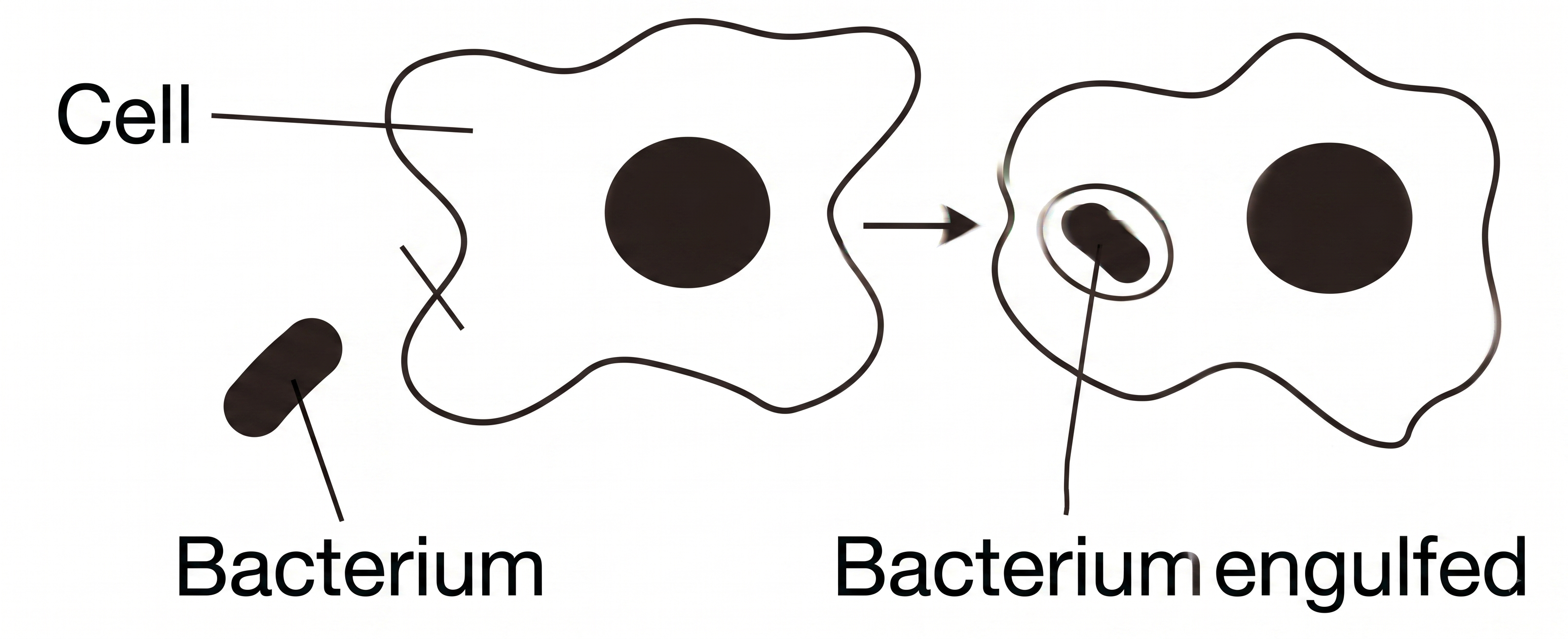
- 18.The diagram above is an illustration of a cell carrying out a biological process. Study it and answer the question below: The biological system that contains cells that carry out the illustrated biological processes in humans is
- A.reproduction
- B.circulatory
- C.respiratory
- D.nervous
Show answerHide answer
Answer: B circulatory
- 19.The diagram above is an illustration of a cell carrying out a biological process. Study it and answer the question below: The process is referred to as
- A.phagocytosis
- B.pinocytosis
- C.endocytosis
- D.exocytosis
Show answerHide answer
Answer: A phagocytosis
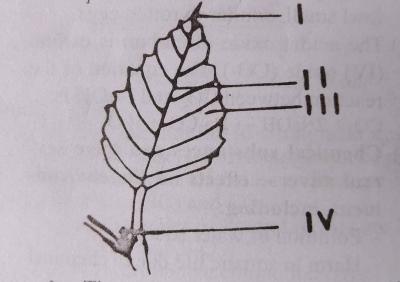
- 20.The diagram above is an illustration of a dicot leaf. Study it and answer the question below. The part that contains the phloem and xylem is labelled
- A.I
- B.II
- C.III
- D.IV
Show answerHide answer
Answer: B II
- 21.The diagram above is an illustration of a dicot leaf. Study it and answer the question below. The parts labelled I,II,III and IV respectively are
- A.vein, apex, midrib, stalk
- B.midrib, petiole, margin, stalk
- C.apex, lamina, blade, axil
- D.apex, midrib, lamina, axil
Show answerHide answer
Answer: A vein, apex, midrib, stalk
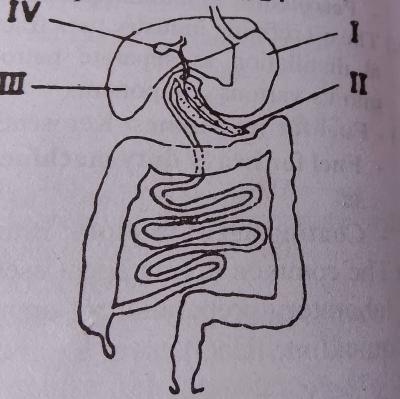
- 22.The diagram above is an illustration of a system in humans. Study it and answer the question below. Enzymatic digestion of protein begins in the part labelled
- A.I
- B.II
- C.III
- D.IV
Show answerHide answer
Answer: A I
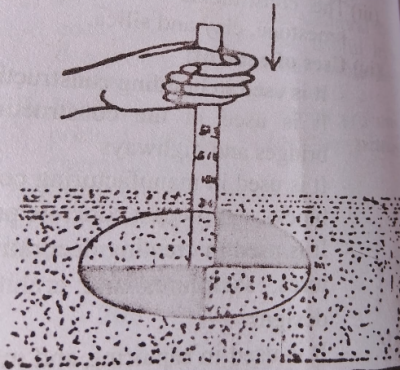
- 23.The diagram above is an illustration of an ecological instrument used in a habitat. Study it and answer question below. The ecological instrument is
- A.wind vane
- B.six's thermometer
- C.secchi disc
- D.hygrometer
Show answerHide answer
Answer: C secchi disc
- 24.The diagram above is an illustration of an ecological instrument used in a habitat. Study it and answer question below. The instrument is used to measure a factor
- A.in the atmosphere
- B.in water
- C.on land
- D.on grass
Show answerHide answer
Answer: B in water
- 25.The diagram above is an illustration of the nymph of an insect. Study it and answer the question below: The growth process that would occur in the organism before it becomes an adult is
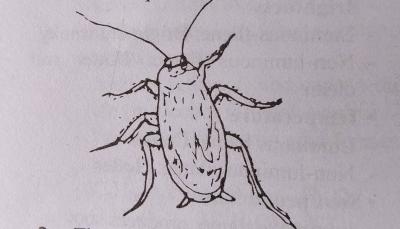
- A.respiration
- B.locomotion
- C.moulting
- D.sensitivity
Show answerHide answer
Answer: C moulting
- 26.The diagram above is an illustration of the nymph of an insect. Study it and answer the question below: The organism illustrated is a stage in the
- A.grasshopper
- B.mosquito
- C.termite
- D.cockroach
Show answerHide answer
Answer: D cockroach
- 27.The diagram below is an illustration of a system in humans. Study it and answer the question below. The parts that secret substances involved in the digestion of fats are labelled
- A.I, II and III
- B.I and III
- C.II and III
- D.I, III and IV
Show answerHide answer
Answer: C II and III
- 28.The following ecological factors affect all habitat except
- A.temperature
- B.humidity
- C.light
- D.pressure
Show answerHide answer
Answer: B humidity
- 29.The functions of vacuoles in plants are storage and
- A.protection
- B.strength
- C.support
- D.sensitivity
Show answerHide answer
Answer: C support
- 30.The Genus into which man is classified is
- A.Chordata
- B.mammalia
- C.homo
- D.sapiens
Show answerHide answer
Answer: C homo
- 31.The main effect of a deforestation is
- A.creation of new habitats
- B.loss of soil particles
- C.survival of more species
- D.reduction of carbon(IV) oxide in the atmosphere
Show answerHide answer
Answer: B loss of soil particles
- 32.The naturally produced auxin in plants is
- A.Indole acetic acid
- B.dichlorophenoxyacetic acid
- C.aldone
- D.florigen
Show answerHide answer
Answer: A Indole acetic acid
- 33.The process occuring in the illustrated molecules above is
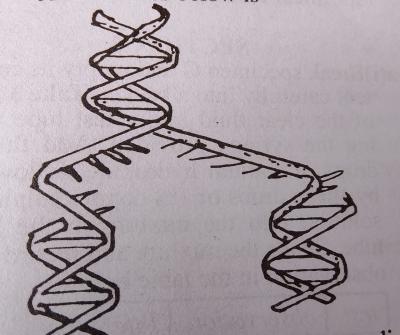
- A.protein synthesis
- B.gene coding
- C.DNA replication
- D.gene mutation
Show answerHide answer
Answer: C DNA replication
- 34.The relationship between a bean plant and a Tridax plant on a farmland is
- A.competition
- B.predation
- C.parasitism
- D.epiphytism
Show answerHide answer
Answer: A competition
- 35.The sympathetic nervous system causes
- A.constriction of the arteries
- B.heartbeat to slow down
- C.increase in the secretion of saliva
- D.contraction of the bladder
Show answerHide answer
Answer: A constriction of the arteries
- 36.The theory of natural selection in evolution was formulated by
- A.Mathias Schleiden
- B.Louis Pasteur
- C.Charles Darwin
- D.Jean Lamarck
Show answerHide answer
Answer: C Charles Darwin
- 37.Urine when compared with blood in mammals is hypertonic because
- A.urine contains high percentage of all cells
- B.all traces of sugar have been removed from urine
- C.urea is actively secreted into the renal tubules
- D.much water has been removed from urine
Show answerHide answer
Answer: D much water has been removed from urine
- 38.What is the population density of Ageratum sp. of frequency 1,850 on a land area measuring 100m \(^2\) ?
- A.18.50/m \(^2\)
- B.18.05/m \(^2\)
- C.0.50/m \(^2\)
- D.0.05/m \(^2\)
Show answerHide answer
Answer: A 18.50/m \(^2\)
- 39.When Tilapias' population in a pond reaches the carrying capacity, the population
- A.alternatively increases and decreases
- B.remains unchanged
- C.increases only
- D.decreases only
Show answerHide answer
Answer: A alternatively increases and decreases
- 40.Which of the following activities does not control pathogens?
- A.exposure to ultraviolet radiation
- B.use of disinfectants
- C.eating balanced diets
- D.destroying the habitats of pathogens
Show answerHide answer
Answer: C eating balanced diets
- 41.Which of the following activities is not suitable for forest conservation?
- A.felling of trees
- B.planting seedlings
- C.preventing bush fires
- D.preventing tree crops
Show answerHide answer
Answer: A felling of trees
- 42.Which of the following diseases could be prevented by a BCG vaccination?
- A.Malaria
- B.Cholera
- C.Tuberculosis
- D.Diphtheria
Show answerHide answer
Answer: C Tuberculosis
- 43.Which of the following pairs of features is an example of discontinuous variation?
- A.height and blood group
- B.height and sex
- C.colour and weight
- D.fingerprint and blood group
Show answerHide answer
Answer: D fingerprint and blood group
- 44.Which of the following resources cannot be conserved?
- A.mineral resources
- B.soil and water
- C.forest and wildlife
- D.domestic wastes
Show answerHide answer
Answer: D domestic wastes
- 45.Which of the following sequences represents the trend in eutrophication?
- A.Heavy mineralization→ lack of oxygen→ massive algal growth
- B.Excessive nitrates→ massive algal growth →lack of oxygen→death of aquatic organisms
- C.Excessive phosphates→lack of oxygen→massive algal growth→ death of aquatic organisms
- D.massive algal growth→excessive nitrates→lack of oxygen
Show answerHide answer
Answer: B Excessive nitrates→ massive algal growth →lack of oxygen→death of aquatic organisms
- 46.Which of the following statements about the pyramid of energy is correct?
- A.Energy remains constant across trophic levels
- B.Energy decreases from the base to the apex of the pyramid
- C.Energy increases from the base to the apex of the pyramid
- D.each trophic level is an independent energy source
Show answerHide answer
Answer: B Energy decreases from the base to the apex of the pyramid
- 47.Which of the following statements correctly describes the term population? The number of
- A.Tilapia in a lake
- B.fungus and snail on leaf litter
- C.bees and butterflies on a flower
- D.flatworms and roundworms in the gut of an animal
Show answerHide answer
Answer: A Tilapia in a lake
- 48.Which of the following statements is not correct about colour blindness?
- A.It is a sex-linked trait
- B.Males are often carriers
- C.females are not carriers
- D.The trait is controlled by a recesive gene
Show answerHide answer
Answer: C females are not carriers
- 49.Which of the following statements is not correct about respiration in plants?
- A.It occurs in all plant tissues
- B.Light and chlorophyll must be present for it to occur
- C.Energy is produced as the end product
- D.It occurs in the presence of oxygen
Show answerHide answer
Answer: B Light and chlorophyll must be present for it to occur
- 50.Which of the following statements is not correct about the dental formula of humans?
- A.One pair of canines is on the upper jaw and three pairs of premolars are on the lower jaw
- B.Two pairs of incisors are the upper jaw and three pairs of premolars are on the lower jaw
- C.Two pairs of incisors are on the upper jaw and three pairs of molars are on the lower jaw
- D.One pair of canines is on the upper jaw and four pairs of molars are on the lower jaw
Show answerHide answer
Answer: C Two pairs of incisors are on the upper jaw and three pairs of molars are on the lower jaw
Printing is turned off here to protect the question bank. Get the SmarTest app to study offline.
More free Biology papers
WAEC Biology 1988–2020 is in the app
The latest five years of each paper are free here. The SmarTest app has every year we hold, a worked explanation for each answer, and timed mock exams. It works offline.
Android, Windows, Mac and Linux